
Красная панда
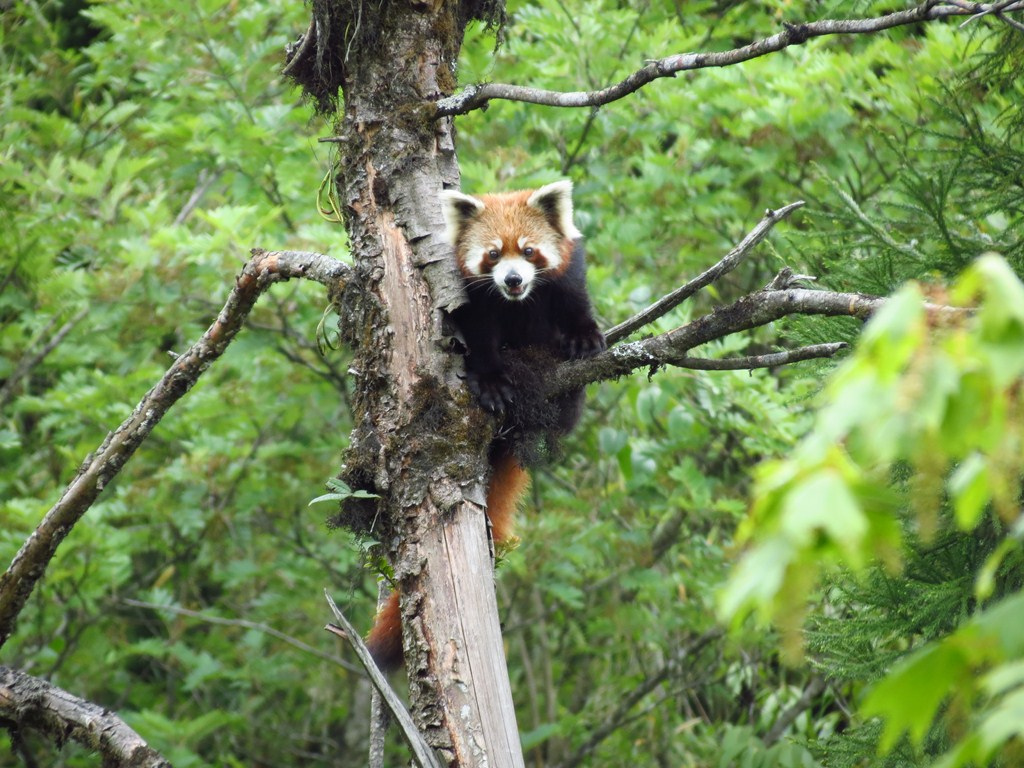
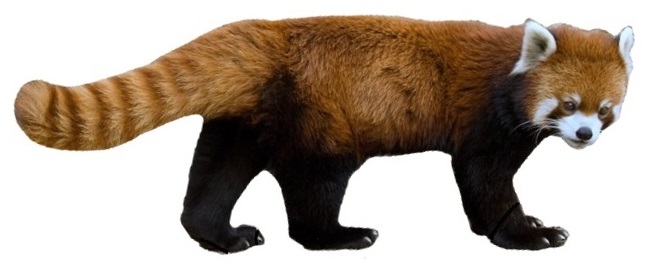
The панда (Ailurus fulgens), also known as the малая панда, is a small млекопитающее, native to the восточных Гималаях and на юго-западе Китая. It has dense reddish-brown fur with a black belly and legs, white-lined ears, a mostly white muzzle and a ringed tail. Its head-to-body length is 51–63.5 cm (20.1–25.0 in) with a 28–48.5 cm (11.0–19.1 in) tail, and it weighs between 3.2 до 15 kg (7.1 and 33.1 lb). It is well adapted to climbing due to its flexible joints and curved semi-retractile claws.
The red panda was formally описана in 1825. The two recognised subspecies, the Himalayan and the Chinese red panda, генетически разошлись about 250,000 years ago. The red panda's place on the эволюционном древе has been debated, but modern genetic evidence places it in close affinity with енотами, ласками, and скунсами. It is not closely related to the гигантской панды, which is a медведям, though both possess elongated wrist bones or "ложные большие пальцы" used for grasping бамбука. The evolutionary линия of the red panda (Ailuridae) stretches back around 25 to 18 назад, as indicated by extinct fossil relatives found in Eurasia and North America.
The red panda inhabits в хвойных лесах, as well as умеренных широколиственных и смешанных лесах, favouring steep slopes with dense bamboo cover close to water sources. It is solitary and largely древесный (tree-dwelling). It feeds mainly on побегами и листьями бамбука and leaves, but also on fruits and blossoms. Red pandas mate in early spring, with the females giving birth to litters of up to four cubs in summer. It is threatened by браконьерства as well as разрушения and фрагментации of habitat due to вырубки лесов. The species has been listed as находящийся on the Красную книгу МСОП как since 2015. It is protected in all странах ареала его распространения.
Программы сохранения вида на основе участия местных сообществ были инициированы в Непале, Бутане и на северо-востоке Индии ; в Китае он получает пользу от проектов по охране природы . В зоопарках по всему миру созданы региональные программы разведения красной панды в неволе. Она фигурирует в анимационных фильмах, видеоиграх, комиксах, а также носит имена компаний и музыкальных групп.
Этимология
The origin of the name «панда» is uncertain, but one of the most likely theories is that it derived from the непальского word "ponya".[4] The word पञ्जा pajā or पौँजा pañjā means "ball of the foot" and "claws".[5] The Nepali words "nigalya ponya" has been translated as "bamboo-footed" and is thought to be the red panda's Nepali name; in English, it was simply called пандой, and was the only animal known under this name for more than 40 years; it became known as the красной пандой or малой пандой, to distinguish it from the гигантской панды, which was formally described and named in 1869.[4]
Название рода Ailurus происходит от древнегреческого слова αἴλουρος ailouros , означающего «кошка». [6] Видовой эпитет fulgens в переводе с латыни означает «сияющий, яркий». [4][7]
Таксономия

Красная панда была описана и названа в 1825 году Фредериком Кювье, который дал ей научное название Ailurus fulgens . Описание Кювье основывалось на зоологических образцах, включая кожу, лапы, челюстные кости и зубы «из гор к северу от Индии», а также на рассказе Альфреда Дювоселя. [9][10] Красная панда была описана ранее Томасом Хардвиком в 1821 году, но его работа была опубликована только в 1827 году. [4][11] В 1902 году Олдфилд Томас описал череп самца красной панды под названием Ailurus fulgens styani в честь Фредерика Уильяма Стяна, который собрал этот экземпляр в провинции Сычуань. [2]
Подвиды и виды

Современная красная панда — единственный признанный вид в роде Ailurus . Традиционно её делят на два подвида: гималайскую красную панду ( A. f. fulgens ) и китайскую красную панду ( A. f. styani ). Гималайский подвид имеет более прямой профиль, более светлый лоб и охристые кончики шерсти на нижней части спины и крестце. Китайский подвид имеет более изогнутый лоб и покатую морду, более тёмную шерсть с менее белой мордой и большим контрастом между кольцами на хвосте. [3]
In 2020, results of a genetic analysis of red panda samples showed that the red panda populations in the Himalayas and China were separated about 250,000 years ago. The researchers suggested that the two subspecies should be treated as distinct species. Red pandas in southeastern Tibet and northern Myanmar were found to be part of A. f. styani , тогда как панды южного Тибета — к виду A. f. fulgens в строгом смысле слова. [12] Секвенирование ДНК 132 образцов фекалий красной панды, собранных на северо-востоке Индии и в Китае, также показало два отдельных кластера, указывающих на то, что река Сианг (Брахмапутра) является границей между гималайской и китайской красными пандами. [13] Вероятно, они разошлись из-за ледниковых событий на южном Тибетском плато в плейстоцене.[14]
Филогения
The placement of the red panda on the эволюционном древе has been debated. In the early 20th century, various scientists placed it in the family вместе with енотами and their allies. At the time, most prominent biologists also considered the red panda to be related to the giant panda, which would eventually be found to be a bear. A 1982 study examined the similarities and differences in the skull between the red panda and the giant panda, other bears and procyonids, and placed the species in its own family Ailuridae. The author of the study considered the red panda to be more closely related to bears.[3] A 1995 Анализ митохондриальной ДНК, analysis revealed that the red panda has close affinities with procyonids.[15] Further genetic studies in 2005, 2018 and 2021 have placed the red panda within the кладу Musteloidea, which also includes Procyonidae, Mustelidae (ласки and relatives) and Mephitidae (скунсы and relatives).[16][17][18]


Ископаемые находки

The family Ailuridae appears to have evolved in Europe in either the позднем олигоцене or миоцене, about 25 to 18 лет назад. The earliest member Amphictis is known from its 10 cm (4 in) skull and may have been around the same size as the modern species. Its зубы consists of sharp premolars and хищных зубов (P4 and m1) and моляров adapted for grinding (M1, M2 and m2), suggesting that it had a generalised плотоядными животными diet. Its placement within Ailuridae is based on the grooves on the side of its клыков. Other early or базальным ailurids include Alopecocyon and Simocyon, whose fossils have been found throughout Eurasia and North America dating from the средним миоценом, the latter of which survived into the раннего плиоцена. Both have similar teeth to Amphictis and thus had a similar diet.[19] The с пуму -sized Simocyon was likely a tree-climber and shared a "false thumb"—an extended wrist bone—with the modern species, suggesting the appendage was an adaptation to древесному передвижению and not to feed on бамбуком.[19][20]
Более поздние и более развитые айлуриды классифицируются в подсемействе Ailurinae и известны как «настоящие» красные панды. Эти животные были меньше по размеру и лучше приспособлены к всеядной или травоядной диете. Самая ранняя известная настоящая панда — Magerictis из среднего миоцена Испании, известная только по одному зубу, нижнему второму моляру. Зуб демонстрирует как исходные, так и новые характеристики, имея относительно низкую и простую коронку, а также удлиненную дробящую поверхность с развитыми зубными бугорками, как у более поздних видов. [21] К более поздним айлуринам относятся Pristinailurus bristoli, обитавший в восточной части Северной Америки с позднего миоцена до раннего плиоцена [21][22], и виды рода Parailurus, которые впервые появились в Европе раннего плиоцена, распространившись по Евразии в Северную Америку. [21][23] Эти животные классифицируются как сестринский таксон по отношению к линии современной красной панды. В отличие от современных травоядных видов, эти древние панды, вероятно, были всеядными, имея сильно заостренные коренные зубы и острые премоляры. [21][22][24]
Самые ранние ископаемые находки современного рода Ailurus датируются не ранее плейстоцена и, по-видимому, были ограничены Азией. Современная линия красной панды адаптировалась к специализированной бамбуковой диете, имея премоляры, похожие на коренные зубы, и более высокие бугорки. [21] Ложный большой палец вторично приобрел функцию в питании. [19][20]
Геномика
Анализ 53 образцов красной панды из провинций Сычуань и Юньнань показал высокий уровень генетического разнообразия. [25] Полный геном красной панды был секвенирован в 2017 году. Исследователи сравнили его с геномом большой панды, чтобы изучить генетику конвергентной эволюции, поскольку оба вида имеют ложные большие пальцы и адаптированы к специализированной бамбуковой диете, несмотря на пищеварительную систему хищника. У обеих панд наблюдаются модификации некоторых генов развития конечностей ( DYNC2H1 и PCNT ), которые могут играть роль в развитии больших пальцев. [26] При переходе от плотоядной к травоядной диете у обоих видов активируются гены вкусовых рецепторов, используемые для обнаружения горечи, хотя конкретные гены различаются. [27]
Описание

The red panda's Шерсть is mainly red or orange-brown with a black belly and legs. The muzzle, cheeks, brows and inner ear margins are mostly white while the bushy tail has red and бежевые ring patterns and a dark brown tip.[28][29][30] The colouration appears to serve as камуфляжем in habitat with red мхом and white лишайником . -covered trees. The Остевые волосы are longer and rougher while the dense подшерсток is fluffier with shorter hairs.[29] The guard hairs on the back have a circular cross-section and are 47–56 mm (1.9–2.2 in) long. It has moderately long усы around the mouth, lower jaw and chin. The hair on the soles of the paws allows the animal to walk in snow.[28]
The red panda has a relatively small head, though proportionally larger than in similarly sized raccoons, with a reduced snout and triangular ears, and nearly evenly lengthed limbs.[28][29] It has a head-body length of 51–63.5 cm (20.1–25.0 in) with a 28–48.5 cm (11.0–19.1 in) tail. The Himalayan red panda is recorded to weigh 3.2–9.4 kg (7.1–20.7 lb), while the Chinese red panda weighs 4–15 kg (8.8–33.1 lb) for females and 4.2–13.4 kg (9.3–29.5 lb) for males.[28] It has five curved пальцев on each foot, each with curved semi-retractile claws that aid in climbing.[29] The задние and hindlimbs have flexible joints, adaptations for an arboreal quadrupedal lifestyle.[31] While not цепкий, the tail helps the animal balance while climbing.[29]
Передние лапы имеют «ложный большой палец», который является продолжением кости запястья, радиальной сесамовидной кости, встречающейся у многих хищников. Этот большой палец позволяет животному цепляться за стебли бамбука, и как пальцы, так и кости запястья обладают высокой гибкостью. Красная панда разделяет эту особенность с большой пандой, у которой сесамовидная кость больше и более сжата по бокам. Кроме того, сесамовидная кость красной панды имеет более утопленный кончик, в то время как у большой панды она изогнута посередине. Эти особенности обеспечивают большой панде более развитую ловкость. [32]
Череп красной панды широкий, а нижняя челюсть массивная. [28][29] Однако, поскольку она питается листьями и стеблями, которые не такие жесткие, у нее более мелкие жевательные мышцы, чем у большой панды. Пищеварительная система красной панды всего в 4.2 раза длиннее ее тела, имеет простой желудок, без заметного разделения между подвздошной кишкой и толстой кишкой и без слепой кишки.[28]
У обоих полов имеются парные анальные железы, выделяющие секрет, состоящий из длинноцепочечных жирных кислот, холестерина, сквалена и 2-пиперидинона ; последний является наиболее пахучим соединением и воспринимается человеком как имеющий аммиачный или перечный запах. [33]
Распространение и среда обитания
The red panda inhabits в Непале; the states of Сикким, Западная Бенгалия, and Аруначал-Прадеш in India; Бутане; northern Мьянме; and southern Тибете, Сычуане, and Юньнане in China.[1] The global potential habitat of the red panda has been estimated to comprise 47,100 km2 (18,200 sq mi) at most; this habitat is located in the умеренной климатической zone of the На всей территории with a mean annual temperature range of 18–24 °C (64–75 °F).[34] Throughout this range, it has been recorded at elevations of 2,000–4,300 m (6,600–14,100 ft).[35][36][37][38][39]
| Страна | Предполагаемый размер [34] |
|---|---|
| Непал | 22,400 km2 (8,600 sq mi) |
| Китай | 13,100 km2 (5,100 sq mi) |
| Индия | 5,700 km2 (2,200 sq mi) |
| Мьянма | 5,000 km2 (1,900 sq mi) |
| Бутан | 900 km2 (350 sq mi) |
| Общий | 47,100 km2 (18,200 sq mi) |
In Nepal, it lives in six protected area complexes within the широколиственных лесов Восточных Гималаев ecoregion.[37] The westernmost records to date were obtained in three общинных лесах in округе Каликот in 2019.[40] и and дикой represent its easternmost range in the country, where its habitat in forest patches is surrounded by villages, livestock в and roads.[41] The metapopulation in protected areas and части in the Бенгалии landscape of Sikkim and northern West Bengal is partly connected through старовозрастные леса outside protected areas.[42] Forests in this landscape are dominated by Himalayan oaks (Quercus lamellosa and Q. semecarpifolia), гималайская береза, гималайская пихта, гималайский клен with bamboo, рододендрон and some черного можжевельника shrub growing in the подлеске.[35][43][44][45] Records in Bhutan, Arunachal Pradesh's Данные из Бутана, долины Панчен, Западный Каменг and районов indicate that it frequents habitats with Yushania and Thamnocalamus bamboo, medium-sized , рододендрона, рябины and каштана trees.[36][46][47] In China, it inhabits the субальпийских хвойных лесах гор Хэндуань and хвойных лесах Цюнлай-Миньшань in the Хэндуань, Цюнлай, Сяосян, Дасянлин and Ляншань in Sichuan.[38] In the adjacent Yunnan province, it was recorded only in the northwestern montane part.[48][49]
The red panda prefers микросреды обитания within 70–240 m (230–790 ft) of water sources.[50][51][52][53] Fallen logs and пни are important habitat features, as they facilitate access to bamboo leaves.[54] Red pandas have been recorded to use steep slopes of more than 20° and stumps exceeding a diameter of 30 cm (12 in).[50][52] Red pandas observed in национальном парке Пхрумсенгла, used foremost easterly and southerly slopes with a mean slope of 34° and a крон cover of 66 per cent that were overgrown with bamboo about 23 m (75 ft) in height.[51] In природном заповеднике Дафэндин, it prefers steep south-facing slopes in winter and inhabits forests with bamboo 1.5–2.5 m (4 ft 11 in – 8 ft 2 in) tall.[55] In национальном природном заповеднике Гаолигуншань, it inhabits mixed coniferous forest with a dense canopy cover of more than 75 per cent, steep slopes and a density of at least 70 растений бамбука/м² 2 (6.5 bamboo plants/sq ft).[56] In some parts of China, the red panda coexists with the giant panda. In Фэнтунчжай and национальных природных заповедниках, red panda microhabitat is characterised by steep slopes with lots of bamboo стеблей, shrubs, fallen logs and stumps, whereas the giant panda prefers gentler slopes with taller but lesser amounts of bamboo and less habitat features overall. Such разделение ниш lessens competition between the two bamboo-eating species.[50][54]
Поведение и экология

Красную панду трудно наблюдать в дикой природе [57], и большинство исследований ее поведения проводилось в неволе [58]. Красная панда, по-видимому, ведет как ночной, так и сумеречный образ жизни, спит по ночам с перерывами. Обычно она отдыхает или спит на деревьях или других возвышенных местах, растянувшись на ветке и свесив ноги, когда ей жарко, и свернувшись калачиком, закрыв лицо задними лапами. Она приспособлена для лазания и спускается на землю головой вперед, держась задними лапами за середину ствола дерева. По земле она быстро передвигается рысью или прыжками [29]
Социальное дистанцирование
Adult pandas are generally одиночный and территориальный образ жизни. Individuals mark their ареал обитания or territorial boundaries with urine, фекалиями and secretions from the анальных and surrounding glands. Scent-marking is usually done on the ground, with males marking more often and for longer periods.[29] In China's В Национальном природном заповеднике Волун, the home range of a radio-collared female was 0.94 km2 (0.36 sq mi), while that of a male was 1.11 km2 (0.43 sq mi).[59] A one-year-long monitoring study of ten red pandas in eastern Nepal showed that the four males had median home ranges of 1.73 km2 (0.67 sq mi) and the six females of 0.94 km2 (0.36 sq mi) within a forest cover of at least 19.2 ha (47 acres). The females travelled 419–841 m (1,375–2,759 ft) per day and the males 660–1,473 m (2,165–4,833 ft). In the mating season from January to March, adults travelled a mean of 795 m (2,608 ft) and subadults a mean of 861 m (2,825 ft).[41] They all had larger home ranges in areas with low forest cover and reduced their activity in areas that were disturbed by people, livestock and dogs.[60]
Рацион и кормление
Красная панда в основном травоядна и питается преимущественно бамбуком, главным образом родами Phyllostachys, Sinarundinaria, Thamnocalamus и Chimonobambusa. [61] Она также питается фруктами, цветами, желудями, яйцами, птицами и мелкими млекопитающими. Листья бамбука могут быть самым распространенным продуктом питания круглый год и единственной пищей, к которой они могут получить доступ зимой. [62] В Национальном природном заповеднике Волун листья вида бамбука Bashania fangiana были обнаружены почти в 94 процентах проанализированных экскрементов, а его побеги — в 59 процентах экскрементов, найденных в июне. [59]
The diet of red pandas monitored at three sites in национальном парке Сингалила for two years consisted of 40–83 per cent Yushania maling and 51–91.2 per cent Thamnocalamus spathiflorus bamboos[a] supplemented by bamboo shoots, Actinidia strigosa fruits and seasonal berries.[65] In this national park, red panda droppings also contained remains of шелковистой розы and плодов ежевики species in the summer season, Actinidia callosa in the post-monsoon season, and Merrilliopanax alpinus, the whitebeam species Sorbus cuspidata and древовидного рододендрона in both seasons. Droppings were found with 23 plant species including the дуба каменного species Lithocarpus pachyphyllus, магнолию Кэмпбелла, the chinquapin species Castanopsis tribuloides, Himalayan birch, Litsea sericea and the падуба species Ilex fragilis.[66] In Nepal's В национальном парке Рара, тамнокаламус was found in all the droppings sampled, both before and after the сезона дождей.[67] Its summer diet in охотничьего заповедника Дхорпатан also includes some lichens and барбарис.[43] In Bhutan's В национальном парке Джигме Дорджи, red panda faeces found in the fruiting season contained seeds of гималайского плюща.[53]
The red panda grabs food with one of its front paws and usually eats sitting down or standing. When foraging for bamboo, it grabs the plant by the stem and pulls it down towards its jaws. It bites the leaves with the side of the зубов and then shears, chews and swallows. Smaller food like blossoms, berries and small leaves are eaten differently, being clipped by the incisors.[29] Having the желудочно-кишечный тракт of a carnivore, the red panda cannot properly digest bamboo, which passes through its gut in two to four hours. Hence, it must consume large amounts of the most nutritious plant matter. It eats over 1.5 kg (3 lb 5 oz) of fresh leaves or 4 kg (9 lb) of fresh shoots in a day with crude proteins and fats being the most easily digested. Digestion is highest in summer and fall but lowest in winter, and is easier for shoots than leaves.[68] The red panda's Скорость метаболизма is comparable to other mammals of its size, despite its poor diet.[69] The red panda digests almost a third of сухого вещества, which is more efficient than the giant panda digesting 17 per cent.[68] Microbes in the gut may aid in its processing of bamboo; the микробиота community in the red panda is less diverse than in other mammals.[70]
Коммуникация
По меньшей мере семь различных вокализаций были зарегистрированы у красной панды, включая рычание, лай, визг, уханье, блеяние, хрюканье и щебетание. Рычание, лай, хрюканье и визг издаются во время драк и агрессивной погони. Уханье издается в ответ на приближение другой особи. Блеяние связано с меткой запаха и обнюхиванием. Самцы могут блеять во время спаривания, а самки щебечут. [71] Как во время игривых, так и агрессивных драк, особи выгибают спину и хвост, медленно двигая головой вверх и вниз. Затем они поворачивают голову, хлопая челюстями, двигают головой в стороны и поднимают переднюю лапу для удара. Они встают на задние лапы, поднимают передние конечности над головой, а затем набрасываются. Две красные панды могут «смотреть» друг на друга издалека. [29]
Размножение и родительство
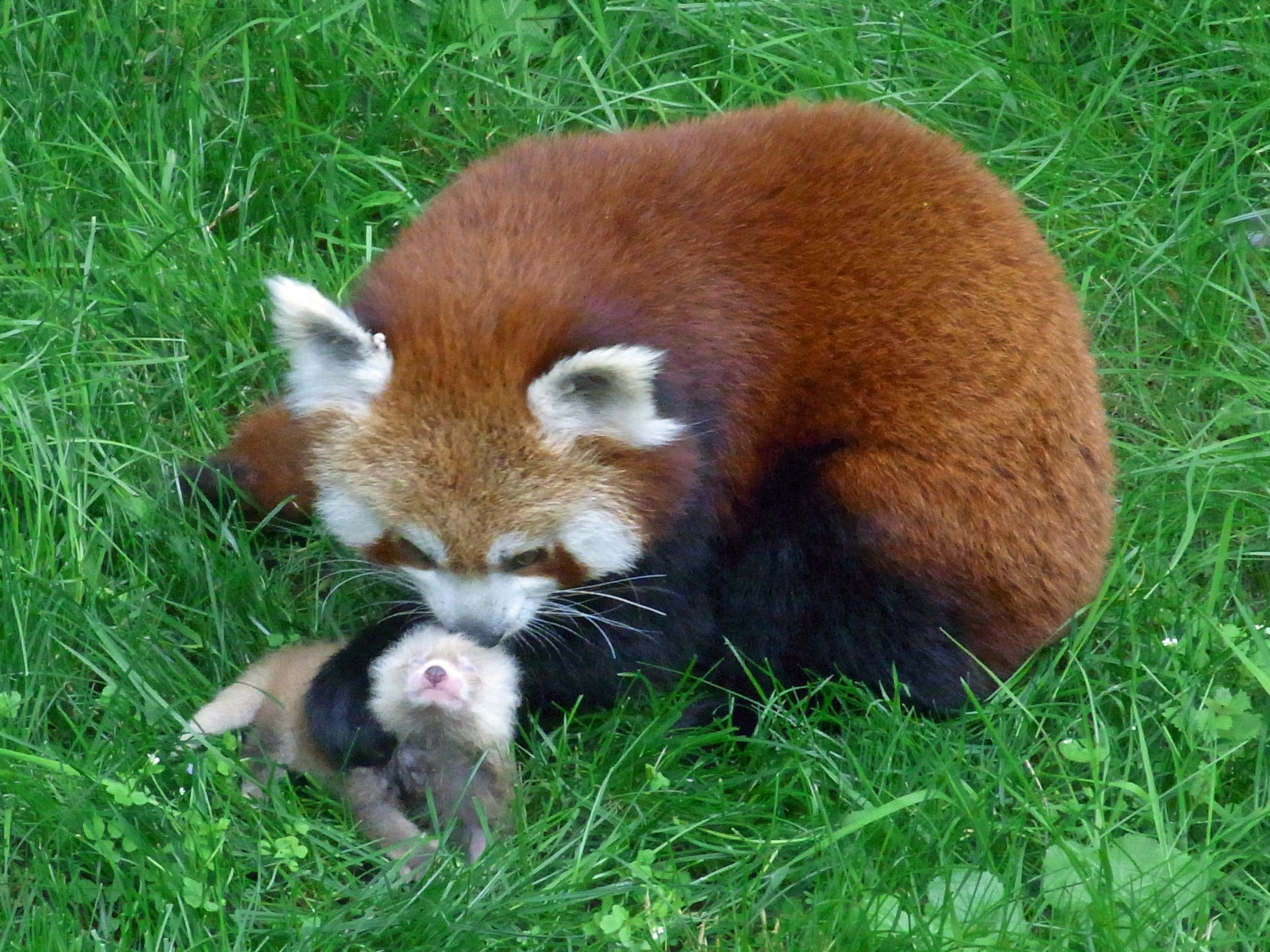
Красные панды размножаются в течение длинного дня, после зимнего солнцестояния, когда световой день становится длиннее. Таким образом, спаривание происходит с января по март, а роды — с мая по август. У панд, содержащихся в неволе в южном полушарии, размножение задерживается на шесть месяцев. Эструс длится один день, и самки могут входить в него несколько раз за сезон, но неизвестно, как долго длятся интервалы между каждым циклом. [72]

С началом репродуктивного сезона самцы и самки больше взаимодействуют, отдыхают, двигаются и кормятся рядом друг с другом. Самка в период течки проводит больше времени, метя территорию, а самцы осматривают ее аногенитальную область. Восприимчивые самки дергают хвостом и принимают позу лордоза, опуская переднюю часть тела к земле и выгибая позвоночник. Спаривание включает в себя запрыгивание самца на самку сзади и сверху, хотя также встречаются спаривания лицом к лицу, а также спаривания животом к спине, лежа на боку. Самец хватает самку за бока передними лапами, а не кусает ее за шею. Интромиссия длится от 2 до 25 минут, и пара вылизывает друг друга между спариваниями. [72]
Беременность длится около 131 дня. [73] Перед родами самка выбирает место для логова, например, дерево, бревно или дупло пня, или расщелину в скале, и строит гнездо, используя материалы из окрестностей, такие как веточки, палочки, сучья, кусочки коры, листья, трава и мох. [57] В помете обычно от одного до четырех детенышей, которые рождаются полностью покрытыми шерстью, но слепыми. Они полностью зависят от матери в течение первых трех-четырех месяцев, пока впервые не покинут гнездо. Они кормятся молоком матери в течение первых пяти месяцев. [73] Связь между матерью и потомством сохраняется до следующего брачного сезона. Детеныши достигают полного роста примерно в 12 месяцев, а половой зрелости – примерно в 18 месяцев . [29] Два детеныша с радиоошейниками в восточном Непале отделились от своих матерей в возрасте 7–8 месяцев и покинули места своего рождения три недели спустя. Они достигли новых территорий обитания в течение 26–42 дней и стали оседлыми после исследования этих территорий в течение 42–44 дней. [41]
Смертность и болезни
Продолжительность жизни красной панды в неволе достигает 14 лет. [29] В дикой природе зафиксированы случаи, когда они становились жертвами леопардов . [74] В образцах фекалий красных панд, собранных в Непале, были обнаружены паразитические простейшие, амебозои, круглые черви, трематоды и ленточные черви. [75][76] Круглые черви, ленточные черви и кокцидии также были обнаружены в экскрементах красных панд, собранных в национальных парках Рара и Лангтанг. [77] Четырнадцать красных панд в зоопарке Ноксвилла страдали от тяжелого стригущего лишая, поэтому двум из них ампутировали хвосты . [78] Болезнь Шагаса была названа причиной смерти красной панды, содержавшейся в зоопарке Канзаса. [79] Амдопарвовирус был обнаружен в экскрементах шести красных панд в зоопарке Сакраменто. [80] Восемь содержащихся в неволе красных панд в китайском зоопарке страдали от одышки и лихорадки незадолго до смерти от пневмонии ; вскрытие показало, что у них были антитела к простейшим Toxoplasma gondii и видам Sarcocystis, что указывает на то, что они были промежуточными хозяями. [81] Одна содержащаяся в неволе красная панда в Чэндуской научно-исследовательской базе по разведению больших панд умерла по неизвестным причинам; вскрытие показало, что ее почки, печень и легкие были повреждены бактериальной инфекцией, вызванной Escherichia coli. [82]
Угрозы
The red panda is primarily threatened by the разрушения and фрагментации of its habitat, the causes of which include increasing human population, вырубка лесов, the unlawful taking of недревесных лесных материалов and disturbances by herders and домашнего скота.[1] Trampling by livestock inhibits bamboo growth,[74] and сплошная вырубка decreases the ability of some bamboo species to regenerate.[83] The cut timber stock in Sichuan alone reached 2,661,000 m3 (94,000,000 cu ft) in 1958–1960, and around 3,597.9 km2 (1,389.2 sq mi) of red panda habitat were logged between the mid-1970s and late 1990s.[48] Throughout Nepal, the red panda habitat outside protected areas is negatively affected by solid waste, livestock trails and herding stations, and people collecting firewood and лекарственные растения.[43][84] Threats identified in Nepal's Угрозы, выявленные в районе Ламджунг include grazing by livestock during seasonal отгонного скотоводства, human-made forest fires and the collection of bamboo as cattle корма для in winter.[85] Vehicular traffic is a significant barrier to red panda movement between habitat patches.[60]
Браконьерство is also a major threat.[1] In Nepal, 121 red panda skins were конфисковано between 2008 and 2018. ловушки, предназначенные для других диких животных, убивали красных панд. meant for other wildlife have been recorded killing red pandas.[86] In Myanmar, the red panda is threatened by hunting using guns and traps; since roads to the border with China were built starting in the early 2000s, red panda skins and live animals have been traded and smuggled across the border.[39] In southwestern China, the red panda is hunted for its fur, especially for the highly valued bushy tails, from which hats are produced. The red panda population in China has been reported to have decreased by 40 per cent over the last 50 years, and the population in western Himalayan areas are considered to be smaller.[48] Between 2005 and 2017, 35 live and seven dead red pandas were confiscated in Sichuan, and several traders were sentenced to 3–12 years of imprisonment. A month-long survey of 65 shops in nine Chinese counties in the spring of 2017 revealed only one in Yunnan offered hats made of red panda skins, and red panda tails were offered in an online forum.[87]
Сохранение
The red panda is listed in Приложение I СИТЕС and protected in all range countries; hunting is illegal. It has been listed as находящаяся под угрозой on the Красную книгу МСОП как since 2008 because the global population is estimated at 10,000 individuals, with a decreasing population trend. A large extent of its habitat is part of protected areas.[1]
В национальном парке Лангтанг создано подразделение по борьбе с браконьерством на красных панд и налажен мониторинг на основе участия местных сообществ. Члены групп пользователей лесных ресурсов также защищают и контролируют места обитания красных панд в других частях Непала. [91] В восточном Непале были инициированы программы работы с местным населением с использованием информационных стендов, радиовещания и ежегодного Международного дня красной панды в сентябре; несколько школ включили руководство по сохранению красной панды в свои учебные программы. [92]
Since 2010, community-based conservation programmes have been initiated in 10 districts in Nepal that aim to help villagers reduce their dependence on natural resources through improved herding and food processing practices and alternative income possibilities. The Nepali government ratified a five-year Red Panda Conservation Action Plan in 2019.[93] From 2016 to 2019, 35 ha (86 acres) of high-elevation пастбищ in Мераке, Бутан, was restored and fenced in cooperation with 120 herder families to protect the red panda forest habitat and improve communal land.[94] Villagers in Arunachal Pradesh established two общинные природоохранные зоны to protect the red panda habitat from disturbance and exploitation of forest resources.[46] China has initiated several projects to protect its environment and wildlife, including «Зерно за зелень», The Natural Forest Protection Project and the National Wildlife/Natural Reserve Construction Project. For the last project, the red panda is not listed as a key species for protection but may benefit from the protection of the giant panda and золотистой курносой обезьяны, with which it overlaps in range.[95]
В неволе
The зоопарк received two red pandas in 1869 and 1876, the first of which was caught in Дарджилинге. The Калькуттский зоопарк received a live red panda in 1877, the Филадельфийский зоопарк — in 1906, and Артиса and зоопарки in 1908. In 1908, the first captive red panda cubs were born in an Indian zoo. In 1940, the зоопарк Сан-Диего imported four red pandas from India that had been caught in Nepal; their first litter was born in 1941. Cubs that were born later were sent to other zoos; by 1969, about 250 red pandas had been exhibited in zoos.[96] The охраны природы Таронга started keeping red pandas in 1977.[97]
In 1978, a племенной реестр, the International Red Panda Studbook, was set up, followed by the Red Panda Европейская программа по сохранению исчезающих видов in 1985. Members of international zoos ratified a global master plan for the разведению of the red panda in 1993. By late 2015, 219 red pandas lived in 42 зоопарках Японии.[98] The Гималайский зоологический парк Падмаджи Найду participates in the Red Panda Плане сохранения вида and kept about 25 red pandas by 2016.[99] By the end of 2019, 182 European zoos kept 407 red pandas.[100] Regional captive breeding programmes have also been established in North American, Australasian and South African zoos.[4]
Культурное значение
The red panda's role in the culture and folklore of local people is limited. A drawing of a red panda exists on a 13th-century Chinese scroll.[101] In Nepal's В районе Тапледжунг, red panda claws are used for treating эпилепсии; its skin is used in rituals for treating sick people, making hats, чучел and decorating houses.[86] In western Nepal, Магар шаманы племени use its skin and fur in their ritual dresses and believe that it protects against evil spirits. People in central Bhutan consider red pandas to be буддийских of Buddhist monks. Some tribal people in northeast India and the народ И believe that it brings good luck to wear red panda tails or hats made of its fur.[101] In China, the fur is used for local cultural ceremonies. At weddings, the bridegroom traditionally carries the hide. Hats made of red panda tails are also used by local newlyweds as a "good-luck charm".[48]
The red panda was recognised as the штата of Sikkim in the early 1990s and was the талисманом of the Darjeeling Tea Festival.[83] It has been featured on stamps and coins issued by several red panda range states. Антропоморфные red pandas feature in анимационных фильмах and TV series such as «Белая змея-волшебница», «Книга джунглей: Приключения Маугли», «Бамбуковые медведи», «Барби в роли принцессы острова», DreamWorks' Кунг-фу Панда», franchise, «Агрецуко» and Disney/Pixar's Красная панда, and in several video games and comic books. It is the название of the Firefox browser and has been used as the namesake of music bands and of companies. Its appearance has been used for plush toys, t-shirts, postcards and other items.[101]
Примечания
Ссылки
- 1 2 3 4 5 6 Глатстон, А.; Вэй, Ф.; Тан Зау и Шерпа, А. (2017) [версия оценки 2015 года с опечатками]. « Аилурус фульгенс ». Красный список исчезающих видов МСОП. 2015 e.T714A110023718 . Проверено 15 января 2022 г.
- 1 2 Thomas, O. (1902). «О панде из Сычуаня». Анналы и журнал естественной истории. 7. X (57): 251–252. doi:10.1080/00222930208678667.
- 1 2 3 Groves, C. (2021). "The taxonomy and phylogeny of Ailurus". In Glatston, A. R. (ed.). Красная панда: биология и сохранение первой панды (Second ed.). London: Academic Press. pp. 95–117. ISBN 978-0-12-823753-3.
- 1 2 3 4 5 Glatston, A. R. (2021). "Introduction". In Glatston, A. R. (ed.). Красная панда: биология и сохранение первой панды (Second ed.). London: Academic Press. pp. xix–xxix. ISBN 978-0-12-823753-3.
- ↑ Turner, R. L. (1931). "पञ्जा pañjā". Сравнительный и этимологический словарь непальского языка. London: K. Paul, Trench, Trübner. p. 359. Заархивировано from the original on 27 January 2022. Retrieved 27 января 2022.
- ↑ Liddell, H. G. & Scott, R. (1940). "αἴλουρος". Греческо-английский лексикон (Revised and augmented ed.). Oxford: Clarendon Press. Заархивировано from the original on 27 February 2021. Retrieved 21 февраля 2021.
- ↑ Lewis, C. T. A. & Short, C. (1879). "fulgens". Латинский словарь (Revised, enlarged, and in great part rewritten ed.). Oxford: Clarendon Press. Заархивировано from the original on 28 February 2021. Retrieved 21 февраля 2021.
- ↑ Lowther, D. A. (2021). "The first painting of the Red Panda (Ailurus fulgens) in Europe? Natural history and artistic patronage in early nineteenth-century India". Архивы естественной истории. 48 (2): 368–376. doi:10.3366/anh.2021.0728. S2CID 244938631.
- ↑ Cuvier, F. (1825). «Панда». In Geoffroy Saint-Hilaire, E.; Cuvier, F. (eds.). Histoire naturelle des mammifères, avec des figures originales, coloriées, dessinées d'après des animaux vivans: publié sous l'autorité de l'administration du Muséum d'Histoire naturelle (in French). Vol. 5. Paris: A. Belin. p. LII 1–3.
- ↑ Cuvier, G. (1829). "Эклатант Панды". Организация Le Règne Animal Distribué d'après son (in French). Vol. 1. Paris: Chez Déterville. p. 138.
- ↑ Hardwicke, T. (1827). «Описание нового рода млекопитающих из Гималайской цепи между Непалом и Снежными горами». Труды Линнеевского общества Лондона. XV: 161–165.
- ↑ Hu, Y.; Thapa, A.; Fan, H.; Ma, T.; Wu, Q.; Ma, S.; Zhang, D.; Wang, B.; Li, M.; Yan, L. & Wei, F. (2020). двух филогенетических видов и долгосрочных популяционных «бутылочных горлышек» у красных панд». Science Advances. 6 (9) eaax5751. Bibcode:2020SciA....6.5751H. doi:10.1126/sciadv.aax5751. PMC 7043915. PMID 32133395.
- ↑ Joshi, B. D.; Dalui, S.; Singh, S. K.; Mukherjee, T.; Chandra, K.; Sharma, L. K. & Thakur, M. (2021). "Siang river in Arunachal Pradesh splits Red Panda into two phylogenetic species". Биология млекопитающих. 101 (1): 121–124. doi:10.1007/s42991-020-00094-y. S2CID 231811193.
- ↑ Dalui, S.; Singh, S. K.; Joshi, B. D.; Ghosh, A.; Basu, S.; Khatri, H.; Sharma, L. K.; Chandra, K. & Thakur, M. (2021). "Geological and Pleistocene glaciations explain the demography and disjunct distribution of Red Panda (A. fulgens) in eastern Himalayas". отчеты. 11 (1): 65. doi:10.1038/s41598-020-80586-6. PMC 7794540. PMID 33420314.
- ↑ Pecon-Slattery, J. & O'Brien, S. J. (1995). "Molecular phylogeny of the red panda (Ailurus fulgens)". Журнал наследственности. 86 (6): 413–422. doi:10.1093/oxfordjournals.jhered.a111615. ПМИД 8568209.
- 1 2 Flynn, J. J.; Finarelli, J. A.; Zehr, S.; Hsu, J. & Nedbal, M. A. (2005). «Молекулярная филогения хищных млекопитающих: оценка влияния увеличения выборки на разрешение загадочных взаимосвязей». Систематическая биология. 54 (2): 317–337. doi:10.1080/10635150590923326. PMID 16012099.
- 1 2 Law, C. J.; Slater, G. J. & Mehta, R. S. (2018). "Разнообразие линий и различия в размерах у Musteloidea: проверка закономерностей адаптивной радиации с использованием молекулярных и ископаемых методов". Систематическая биология. 67 (1): 127–144. doi:10.1093/sysbio/syx047. PMID 28472434.
- 1 2 Hassanin, A.; Veron, G.; Ropiquet, A.; van Vuuren, B. J.; Lécu, A.; Goodman, S. M.; Haider, J.; Nguyen, T. T. (2021). «Эволюционная история хищных животных (Mammalia, Laurasiatheria), выведенная на основе митохондриальных геномов». ПЛОС ОДИН. 16 (2) e0240770. Бибкод:2021PLoSO..1640770H. дои:10.1371/journal.pone.0240770. ПМЦ 7886153. ПМИД 33591975.
- 1 2 3 Salesa, M. J.; Peigné, S.; Antón, M. & Morales, J. (2021). "The taxonomy and phylogeny of Ailurus". In Glatston, A. R. (ed.). Красная панда: биология и сохранение первой панды (Second ed.). London: Academic Press. pp. 15–29. ISBN 978-0-12-823753-3.
- 1 2 Salesa, M. J.; Mauricio, A.; Peigné, S. & Morales, J. (2006). "Evidence of a false thumb in a fossil carnivore clarifies the evolution of pandas". PNAS. 103 (2): 379–382. Bibcode:2006PNAS..103..379S. doi:10.1073/pnas.0504899102. PMC 1326154. PMID 16387860.
- 1 2 3 4 5 Wallace, S. C. & Lyon, L. (2021). "Systemic revision of the Ailurinae (Mammalia: Carnivora: Ailuridae): with a new species from North America". In Glatston, A. R. (ed.). Красная панда: биология и сохранение первой панды (Second ed.). London: Academic Press. pp. 31–52. ISBN 978-0-12-823753-3.
- 1 2 Wallace, S. C. & Wang, X. (2004). «Два новых хищника из необычной позднетретичной лесной биоты восточной Северной Америки» (PDF). Nature. 431 (7008): 556–559. Bibcode:2004Natur.431..556W. doi:10.1038/nature02819. PMID 15457257. S2CID 4432191.
- ↑ Tedford, R. H. & Gustafson, E. P. (1977). "First North American record of the extinct panda Parailurus". Nature. 265 (5595): 621–623. Bibcode:1977Natur.265..621T. doi:10.1038/265621a0. S2CID 4214900.
- ↑ Sotnikova, M. V. (2008). "A new species of lesser panda Parailurus (Mammalia, Carnivora) from the Pliocene of Transbaikalia (Russia) and some aspects of ailurine phylogeny". Палеонтологический журнал. 42 (1): 90–99. Библиографический код:2008PalJ...42...90S. doi:10.1007/S11492-008-1015-X. S2CID 82000411.
- ↑ Su, B.; Fu, Y.; Wang, Y.; Jin, L. & Chakraborty, R. (2001). "Genetic diversity and population history of the Red Panda (Ailurus fulgens) as inferred from mitochondrial DNA sequence variations". Молекулярная биология и эволюция. 18 (6): 1070–1076. doi:10.1093/oxfordjournals.molbev.a003878. PMID 11371595.
- ↑ Hu, Y.; Wu, Q.; Ma, S.; Ma, T.; Shan, L.; Wang, X.; Nie, Y.; Ning, Z.; Yan, L.; Xiu, Y. & Wei, F. (2017). питающейся бамбуком, и красной пандой». Труды Национальной академии наук. 114 (5): 1081–1086. Библиографический код:2017PNAS..114.1081H. doi:10.1073/pnas.1613870114. PMC 5293045. PMID 28096377.
- ↑ Shan, L.; Wu, Q.; Wange, L.; Zhang, L. & Wei, F. (2017). у больших и красных панд подразумевает адаптацию к рациону питания». Интегративная зоология. 13 (2): 152–159. doi:10.1111/1749-4877.12291. PMC 5873442. PMID 29168616.
- 1 2 3 4 5 6 Fisher, Rebecca E. (2021). "Red Panda Anatomy". In Glatston, Angela R. (ed.). Красная панда: биология и сохранение первой панды (2nd ed.). London: Academic Press. pp. 81–93. doi:10.1016/B978-0-12-823753-3.00030-2. ISBN 978-0-12-823753-3. S2CID 243824295.
- 1 2 3 4 5 6 7 8 9 10 11 12 Roberts, M. S. & Gittleman, J. L. (1984). "Ailurus fulgens" (PDF). Виды млекопитающих (222): 1–8. Библиографический код:1984MamSp.222....1R. doi:10.2307/3503840. JSTOR 3503840. S2CID 253993605. Заархивировано (PDF) from the original on 1 December 2017. Retrieved 1 декабря 2017.
- ↑ Wozencraft, W. C. (2013). "Carnivora". In Xie, Y.; Smith, A. T.; Smith, D. E.; Hoffmann, R. S.; Wozencraft, W. C.; MacKinnon, J. R.; Lunde, D. (eds.). Млекопитающие Китая. Princeton University Press. p. 334. ISBN 978-0-691-15427-5.
- ↑ Makungu, M.; du Plessis, W. M.; Groenewald, H. B.; Barrows, M. & Koeppel, K. N. (2015). "Morphology of the pelvis and hind limb of the Red Panda (Ailurus fulgens) evidenced by gross osteology, radiography and computed tomography". Anatomia, Histologia, Embryologia. 44 (6): 410–421. doi:10.1111/ahe.12152. hdl:2263/50447. PMID 25308447. S2CID 13035672.
- ↑ Antón, M.; Salesa, M. J.; Pastor, J. F.; Peigné, S. & Morales, J. (2006). "Implications of the functional anatomy of the hand and forearm of Ailurus fulgens (Carnivora, Ailuridae) for the evolution of the 'false-thumb' in pandas". анатомии. 209 (6): 757–764. doi:10.1111/j.1469-7580.2006.00649.x. PMC 2049003. PMID 17118063.
- ↑ Wood, W. F.; Dragoo, G. A.; Richard, M. J.; Dragoo, J. W. (2003). "Long-chain fatty acids in the anal gland of the red panda, Ailurus fulgens". Биохимическая систематика и экология. 31 (9): 1057–1060. Библиографический код:2003BioSE..31.1057W. doi:10.1016/S0305-1978(03)00060-7.
- 1 2 Kandel, K.; Huettmann, F.; Suwal, M. K.; Regmi, G. R.; Nijman, V.; Nekaris, K. A. I.; Lama, S. T.; Thapa, A.; Sharma, H. P. & Subedi, T. R. (2015). "Rapid multi-nation distribution assessment of a charismatic conservation species using open access ensemble model GIS predictions: Red Panda (Ailurus fulgens) in the Hindu-Kush Himalaya region". Биологическая охрана природы. 181: 150–161. Bibcode:2015BCons.181..150K. doi:10.1016/j.biocon.2014.10.007.
- 1 2 Mallick, J. K. (2010). "Status of Red Panda Ailurus fulgens in Neora Valley National Park, Darjeeling District, West Bengal, India". Сохранение мелких хищников. 43: 30–36. Заархивировано from the original on 18 March 2022. Retrieved 18 марта 2022.
- 1 2 3 Dorji, S.; Rajaratnam, R. & Vernes, K. (2012). "The Vulnerable Red Panda Ailurus fulgens in Bhutan: distribution, conservation, status and management recommendations". Орикс. 46 (4): 536–543. Бибкод:2012Oryx...46..536D. дои:10.1017/S0030605311000780. S2CID 84332758.
- 1 2 3 Thapa, K.; Thapa, G. J.; Bista, D.; Jnawali, S. R.; Acharya, K. P.; Khanal, K.; Kandel, R. C.; Karki Thapa, M.; Shrestha, S.; Lama, S. T. & Sapkota, N. S. (2020). "Landscape variables affecting the Himalayan Red Panda Ailurus fulgens occupancy in wet season along the mountains in Nepal". PLoS One. 15 (12) e0243450. Bibcode:2020PLoSO..1543450T. doi:10.1371/journal.pone.0243450. PMC 7740865. PMID 33306732.
- 1 2 3 Dong, X.; Zhang, J.; Gu, X.; Wang, Y.; Bai, W. & Huang, Q. (2021). "Evaluating habitat suitability and potential dispersal corridors across the distribution landscape of the Chinese Red Panda (Ailurus styani) in Sichuan, China". Global Ecology and Conservation. 28 e01705. Bibcode:2021GEcoC..2801705D. doi:10.1016/j.gecco.2021.e01705.
- 1 2 3 Lin, A. K.; Lwin, N.; Aung, S. S.; Oo, W. N.; Lum, L. Z. & Grindley, M. (2021). «Состояние сохранения красной панды на северо-востоке Мьянмы». In Glatston, A. R. (ed.). Биология и сохранение первой панды (Second ed.). London: Academic Press. pp. 475–488. ISBN 978-0-12-823754-0. Архивировано from the original on 29 January 2022Дата обращения: 24 января 2022 года.
- ↑ Shrestha, S.; Lama, S.; Sherpa, A. P.; Ghale, D. & Lama, S. T. (2021). «Находящаяся под угрозой исчезновения гималайская красная панда: первые фотографические свидетельства из самой западной части ее ареала распространения». Журнал находящихся под угрозой исчезновения таксонов. 13 (5): 18156–18163. doi:10.11609/jott.6100.13.5.18156-18163.
- 1 2 3 Bista, D.; Baxter, G. S.; Hudson, N. J.; Lama, S. T.; Weerman, J. & Murray, P. J. (2021). «Перемещение и расселение специалиста по местообитаниям в ландшафтах, подверженных влиянию человека: тематическое исследование красной панды». Экология движения. 9 (1): 62. Библиографический код:2021MvEco...9...62B. doi:10.1186/s40462-021-00297-z. PMC 8670026. PMID 34906253.
- 1 2 Dalui, S.; Khatri, H.; Singh, S. K.; Basu, S.; Ghosh, A.; Mukherjee, T.; Sharma, L. K.; Singh, R.; Chandra, K. & Thakur, M. (2020). "Fine-scale landscape genetics unveiling contemporary asymmetric movement of Red Panda (Ailurus fulgens) in Kangchenjunga landscape, India". Научные отчеты. 10 (1): 15446. Бибкод:2020NatSR..1015446D. дои:10.1038/s41598-020-72427-3. ПМЦ 7508845. ПМИД 32963325.
- 1 2 3 Panthi, S.; Aryal, A.; Raubenheimer, D.; Lord, J. & Adhikari, B. (2012). "Summer diet and distribution of the Red Panda (Ailurus fulgens fulgens) in Dhorpatan Hunting Reserve, Nepal" (PDF). Зоологические исследования. 51 (5): 701–709. Заархивировано (PDF) from the original on 22 March 2022. Retrieved 18 марта 2022.
- ↑ Khatiwara, S. & Srivastava, T. (2014). "Red Panda Ailurus fulgens and other small carnivores in Kyongnosla Alpine Sanctuary, East Sikkim, India". Сохранение мелких хищников. 50: 35–38. Заархивировано from the original on 13 February 2020. Retrieved 18 марта 2022.
- ↑ Bashir, T.; Bhattacharya, T.; Poudyal, K. & Sathyakumar, S. (2019). "First camera trap record of Red Panda Ailurus fulgens (Cuvier, 1825) (Mammalia: Carnivora: Ailuridae) from Khangchendzonga, Sikkim, India". Журнал таксонов, находящихся под угрозой исчезновения. 11 (8): 14056–14061. doi:10.11609/jott.4626.11.8.14056-14061.
- 1 2 Chakraborty, R.; Nahmo, L. T.; Dutta, P. K.; Srivastava, T.; Mazumdar, K. & Dorji, D. (2015). "Status, abundance, and habitat associations of the Red Panda (Ailurus fulgens) in Pangchen Valley, Arunachal Pradesh, India". Млекопитающие. 79 (1): 25–32. doi:10.1515/mammalia-2013-0105. S2CID 87668179.
- ↑ Megha, M.; Christi, S.; Kapoor, M.; Gopal, R. & Solanki, R. (2021). "Photographic evidence of Red Panda Ailurus fulgens Cuvier, 1825 from West Kameng and Shi-Yomi districts of Arunachal Pradesh, India". Журнал таксонов, находящихся под угрозой исчезновения. 13 (9): 19254–19262. doi:10.11609/jott.6666.13.9.19254-19262.
- 1 2 3 4 Wei, F.; Feng, Z.; Wang, Z. & Hu, J. (1999). "Current distribution, status and conservation of wild Red Pandas Ailurus fulgens in China". Биологическая охрана природы. 89 (3): 285–291. Библиографический код:1999BCons..89..285W. doi:10.1016/S0006-3207(98)00156-6.
- ↑ Li, F.; Huang, X. Y.; Zhang, X. C.; Zhao, X. X.; Yang, J. H. & Chan, B. P. L. (2019). «Млекопитающие секции Тэнчун Национального природного заповедника Гаолигуншань в провинции Юньнань, Китай». Журнал угрожаемых таксонов. 11 (11): 14402–14414. doi:10.11609/jott.4439.11.11.14402-14414.
- 1 2 3 4 Wei, F.; Feng, Z.; Wang, Z. & Hu, J. (2000). «Использование местообитаний и разделение между гигантской пандой и красной пандой». Журнал маммологии. 81 (2): 448–455. doi:10.1644/1545-1542(2000)081<0448:HUASBT>2.0.CO;2.
- 1 2 Dorji, S.; Vernes, K. & Rajaratnam, R. (2011). «Корреляты местообитаний красной панды в умеренных лесах Бутана». PLoS One. 6 (10) e26483. Библиографический код:2011PLoSO...626483D. doi:10.1371/journal.pone.0026483. PMC 3198399. PMID 22039497.
- 1 2 Dendup, P.; Lham, C.; Wangchuk, J. & Tshering, K. (2018). "Winter habitat preferences of Endangered Red Panda (Ailurus fulgens) in the Forest Research Preserve of Ugyen Wangchuck Institute for Conservation and Environmental Research, Bumthang, Bhutan". Журнал Бутанского экологического общества. 3: 1–13. ISSN 2410-3861. Заархивировано from the original on 10 May 2021. Retrieved 18 марта 2022.
- 1 2 Dendup, P.; Humle, T.; Bista, D.; Penjor, U.; Lham, C. & Gyeltshen, J. (2020). "Habitat requirements of the Himalayan Red Panda (Ailurus fulgens) and threat analysis in Jigme Dorji National Park, Bhutan". и эволюция. 10 (17): 9444–9453. Библиографический код:2020EcoEv..10.9444D. doi:10.1002/ece3.6632. PMC 7487235. PMID 32953073.
- 1 2 3 Zhang, Z.; Wei, F.; Li, M. & Hu, J. (2006). "Winter microhabitat separation between Giant and Red Pandas in Bashania faberi Bamboo forest in Fengtongzhai Nature Reserve". Журнал управления дикой природой. 70 (1): 231–235. doi:10.2193/0022-541X(2006)70[231:WMSBGA]2.0.CO;2. S2CID 86350625.
- 1 2 Zhou, X.; Jiao, H.; Dou, Y.; Aryal, A.; Hu, J.; Hu, J. & Meng, X. (2013). "The winter habitat selection of Red Panda (Ailurus fulgens) in the Meigu Dafengding National Nature Reserve, China" (PDF). Current Science. 105 (10): 1425–1429. Заархивировано (PDF) from the original on 22 March 2022. Retrieved 18 марта 2022.
- 1 2 Liu, X.; Teng, L.; Ding, Y. & Liu, Z. (2021). "Habitat selection by Red Panda (Ailurus fulgens fulgens) in Gaoligongshan Nature Reserve, China" (PDF). Пакистанский зоологический журнал. 54 (4). дои:10.17582/journal.pjz/20190726090725. S2CID 238963119. Архивировано (PDF) from the original on 28 January 2022. Retrieved 28 января 2022.
- 1 2 Gebauer, A. (2021). "The early days: maternal behaviour and infant development". In Glatston, A. R. (ed.). Красная панда: биология и сохранение первой панды (Second ed.). London: Academic Press. pp. 149–179. ISBN 978-0-12-823753-3.
- ↑ Karki, S.; Maraseni, T.; Mackey, B.; Bista, D.; Lama, S. T.; Gautam, A. P.; Sherpa, A. P.; Koju, A. P.; Koju, U.; Shrestha, A. & Cadman, T. (2021). "Reaching over the gap: A review of trends in and status of red panda research over 193 years (1827–2020)". Science of the Total Environment. 781 146659. Bibcode:2021ScTEn.78146659K. doi:10.1016/j.scitotenv.2021.146659. hdl:10072/403744. PMID 33794452. S2CID 232763016.
- 1 2 3 Reid, D. G.; Jinchu, H. & Yan, H. (1991). "Ecology of the Red Panda Ailurus fulgens in the Wolong Reserve, China". Журнал зоологии. 225 (3): 347–364. Бибкод:1991JZoo..225..347R. дои:10.1111/j.1469-7998.1991.tb03821.x.
- 1 2 Bista, D.; Baxter, G. S.; Hudson, N. J.; Lama, S. T. & Murray, P. J. (2021). Влияние нарушений и фрагментации местообитаний на млекопитающего, специализирующегося на древесных местообитаниях, с использованием GPS-телеметрии: случай красной панды». Ландшафтная экология. 37 (3): 795–809. doi:10.1007/s10980-021-01357-w. PMC 8542365. PMID 34720409.
- ↑ Nijboer, J. & Dierenfeld, E. S. (2021). "Red panda nutrition: how to feed a vegetarian carnivore". In Glatston, A. R. (ed.). Красная панда: биология и сохранение первой панды (Second ed.). London: Academic Press. pp. 225–238. ISBN 978-0-12-823753-3.
- ↑ Wei, F.; Thapa, A.; Hu, Y. & Zhang, Z. (2021). "Red Panda ecology". In Glatston, A. R. (ed.). Красная панда: биология и сохранение первой панды (Second ed.). London: Academic Press. pp. 329–351. ISBN 978-0-12-823753-3.
- ↑ Stapleton, C. M. A. (1994). "The bamboos of Nepal and Bhutan. Part II: Arundinaria, Thamnocalamus, Borinda, and Yushania (Gramineae: Poaceae, Bambusoideae)". Эдинбургский журнал ботаники. 51 (2): 275–295. doi:10.1017/S0960428600000883.
- ↑ Triplett, J. K. & Clark, L. G. (2010). "Phylogeny of the temperate bamboos (Poaceae: Bambusoideae: Bambuseae) with an emphasis on Arundinaria and allies". Систематическая ботаника. 35 (1): 102–120. Библиографический код:2010SysBo..35..102T. doi:10.1600/036364410790862678. S2CID 85588401.
- ↑ Pradhan, S.; Saha, G. K. & Khan, J. A. (2001). "Ecology of the Red Panda Ailurus fulgens in the Singhalila National Park, Darjeeling, India". Биологическая охрана природы. 98 (1): 11–18. Библиографический код:2001BCons..98...11P. doi:10.1016/S0006-3207(00)00079-3.
- ↑ Roka, B.; Jha, A. K. & Chhetri, D. R. (2021). "A study on plant preferences of Red Panda (Ailurus fulgens) in the wild habitat: foundation for the conservation of the species". Acta Biologica Sibirica. 7: 425–439. doi:10.3897/abs.7.e71816. S2CID 244942192. Заархивировано from the original on 28 June 2022. Retrieved 29 января 2022.
- ↑ Sharma, H. R.; Swenson, J. E. & Belant, J. (2014). "Seasonal food habits of the Red Panda (Ailurus fulgens) in Rara National Park, Nepal". Hystrix. 25 (1): 47–50. doi:10.4404/hystrix-25.1-9033.
- 1 2 Wei, F.; Feng, Z.; Wang, Z.; Zhou, A. & Hu, J. (1999). "Use of the nutrients in bamboo by the Red Panda Ailurus fulgens". Журнал зоологии. 248 (4): 535–541. Библиографический код:1999JZoo..248..535W. doi:10.1111/j.1469-7998.1999.tb01053.x.
- ↑ Fei, Y.; Hou, R.; Spotila, J. R.; Paladino, F. V.; Qi, D. & Zhang, Z. (2017). "Metabolic rate of the Red Panda, Ailurus fulgens, a dietary bamboo specialist". ПЛОС ОДИН. 12 (3) e0173274. Бибкод:2017PLoSO..1273274F. дои:10.1371/journal.pone.0173274. ПМЦ 5356995. ПМИД 28306740.
- ↑ Kong, F.; Zhao, J.; Han, S.; Zeng, B.; Yang, J.; Si, X.; Yang, B.; Yang, M.; Xu, H. & Li, Y. (2014). "Characterization of the gut microbiota in the red panda (Ailurus fulgens)". PLOS ONE. 9 (2) e87885. Библиографический код:2014PLoSO...987885K. doi:10.1371/journal.pone.0087885. PMC 3912123. PMID 24498390.
- ↑ Qi, D.; Zhou, H.; Wei, W.; Lei, M.; Yuan, S.; Qi, D. & Zhang, Z. (2016). "Vocal repertoire of adult captive red pandas (Ailurus fulgens)". Биология животных. 66 (2): 145–155. doi:10.1163/15707563-00002493.
- 1 2 Curry, E. (2021). "Reproductive biology of the Red Panda". In Glatston, A. R. (ed.). Красная панда: биология и сохранение первой панды (Second ed.). London: Academic Press. pp. 119–138. ISBN 978-0-12-823753-3.
- 1 2 Roberts, M. S. & Kessler, D. S. (1979). "Reproduction in Red pandas, Ailurus fulgens (Carnivora: Ailuropodidae)". Журнал зоологии. 188 (2): 235–249. doi:10.1111/j.1469-7998.1979.tb03402.x.
- 1 2 Yonzon, P. B. & Hunter, M. L. Jr. (1991). "Conservation of the Red Panda Ailurus fulgens". Биологическая охрана природы. 57 (1): 1–11. Библиографический код:1991BCons..57....1Y. doi:10.1016/0006-3207(91)90104-H.
- ↑ Lama, S. T.; Lama, R. P.; Regmi, G. R. & Ghimire, T. R. (2015). "Prevalence of intestinal parasitic infections in free-ranging Red Panda Ailurus fulgens Cuvier, 1825 (Mammalia: Carnivora: Ailuridae) in Nepal". Журнал таксонов, находящихся под угрозой исчезновения. 7 (8): 7460–7464. doi:10.11609/JoTT.o4208.7460-4.
- ↑ Bista, D.; Shrestha, S.; Kunwar, A. J.; Acharya, S.; Jnawali, S. R. & Acharya, K. P. (2017). «Состояние желудочно-кишечных паразитов у красной панды в Непале». PeerJ. 5 e3767. doi:10.7717/peerj.3767. PMC 5591639. PMID 28894643.
- ↑ Sharma, H. P. & Achhami, B. (2021). «Желудочно-кишечные паразиты симпатрических красных панд и домашнего скота в охраняемых районах Непала». и наука. 8 (2): 568–577. doi:10.1002/vms3.651. PMC 8959333. PMID 34599791. S2CID 238250774.
- ↑ Kearns, K. S.; Pollock, C. G. & Ramsay, E. C. (1999). "Dermatophytosis in Red Pandas (Ailurus fulgens fulgens): a review of 14 cases". зоологической и дикой медицины. 30 (4): 561–563. JSTOR 20095922. PMID 10749446.
- ↑ Huckins, G. L.; Eshar, D.; Schwartz, D.; Morton, M.; Herrin, B. H.; Cerezo, A.; Yabsley, M. J. & Schneider, S. M. (2019). "Trypanosoma cruzi infection in a zoo-housed Red Panda in Kansas". ветеринарной диагностической экспертизы. 31 (5): 752–755. doi:10.1177/1040638719865926. PMC 6727118. PMID 31342874.
- ↑ Alex, C. E.; Kubiski, S. V.; Li, L.; Sadeghi, M.; Wack, R. F.; McCarthy, M. A.; Pesavento, J. B.; Delwart, E. & Pesavento, P. A. (2018). "Амдопарвовирусная infection in Red Pandas (Ailurus fulgens)". Ветеринарная патология. 55 (4): 552–561. doi:10.1177/0300985818758470. ПМИД 29433401.
- ↑ Yang, Y.; Dong, H.; Su, R.; Li, T.; Jiang, N.; Su, C. & Zhang, L. (2019). "Evidence of Red Panda as an intermediate host of Toxoplasma gondii and Sarcocystis species". Международный журнал паразитологии: паразиты и дикая природа. 8: 188–191. код:2019IJPPW...8..188Y. doi:10.1016/j.ijppaw.2019.02.006. PMC 6403407. PMID 30891398.
- ↑ Liu, S.; Li, Y.; Yue, C.; Zhang, D.; Su, X.; Yan, X.; Yang, K.; Chen, X.; Zhuo, G.; Cai, T.; Liu, J.; Peng, X. & Huo, R. (2020). "Isolation and characterization of uropathogenic Escherichia coli (UPEC) from Red Panda (Ailurus fulgens)". BMC Veterinary Research. 16 (1): 404. doi:10.1186/s12917-020-02624-9. PMC 7590469. PMID 33109179.
- 1 2 Glatson, A. R. (1994). "The Red Panda or Lesser Panda (Ailurus fulgens)" (PDF). Обзор состояния популяции и план действий по сохранению айлурид. Красная панда, олинго, коати, еноты и их родственники. Gland, Switzerland: IUCN/SSC Mustelid, Viverrid, and Procyonid Specialist Group. pp. 8, 12. ISBN 2-8317-0046-9. Archived (PDF) from the original on 8 March 2021. Retrieved 7 July 2020.
- ↑ Acharya, K. P.; Shrestha, S.; Paudel, P. K.; Sherpa, A. P.; Jnawali, S. R.; Acharya, S. & Bista, D. (2018). "Pervasive human disturbance on habitats of endangered Red Panda Ailurus fulgens in the central Himalaya". Global Ecology and Conservation. 15 e00420. Bibcode:2018GEcoC..1500420A. doi:10.1016/j.gecco.2018.e00420. S2CID 92988737.
- ↑ Ghimire, G.; Pearch, M.; Baral, B.; Thapa, B. & Baral, R. (2019). "The first photographic record of the Red Panda Ailurus fulgens (Cuvier, 1825) from Lamjung District outside Annapurna Conservation Area, Nepal". Журнал таксонов, находящихся под угрозой исчезновения. 11 (12): 14576–14581. doi:10.11609/jott.4828.11.12.14576-14581.
- 1 2 Bista, D.; Baxter, G. S. & Murray, P. J. (2020). "What is driving the increased demand for red panda pelts?". Человеческий аспект дикой природы. 25 (4): 324–338. Библиографический код:2020HDW....25..324B. doi:10.1080/10871209.2020.1728788. S2CID 213958948.
- ↑ Xu, L. & Guan, J. (2018). Результаты исследования рынка «Красная панда» в Китае (PDF). Cambridge: Traffic. Архивная (PDF) from the original on 28 January 2022. Retrieved 28 января 2022.
- ↑ Datta, A.; Naniwadekar, R. & Anand, M. O. (2008). «Распространение и природоохранный статус мелких хищников в двух охраняемых районах Аруначал-Прадеша, северо-восточная Индия». Сохранение мелких хищников. 39: 1–10. Заархивировано from the original on 28 June 2022. Retrieved 18 марта 2022.
- ↑ Lwin, Y. H.; Wang, L.; Li, G.; Maung, K. W.; Swa, K. & Quan, R. C. (2021). «Разнообразие, распространение и сохранение крупных млекопитающих в северной Мьянме». Глобальная экология и охрана природы. 29 e01736. Библиографический код:2021GEcoC..2901736L. doi:10.1016/j.gecco.2021.e01736.
- ↑ Li, X.; Bleisch, W. V.; Liu, X. & Jiang, X. (2021). «Исследования с помощью фотоловушек выявляют высокое разнообразие млекопитающих и фазанов в Медоге, Тибет». Oryx. 55 (2): 177–180. doi:10.1017/S0030605319001467.
- ↑ Thapa, A.; Hu, Y. & Wei, F. (2018). "The endangered Red Panda (Ailurus fulgens): Ecology and conservation approaches across the entire range". Биологическая охрана природы. 220: 112–121. Bibcode:2018BCons.220..112T. doi:10.1016/j.biocon.2018.02.014.
- ↑ Bista, D. (2018). «Сообщества на передовой линии охраны красной панды, восточный Непал» (PDF). Гималайский натуралист. 1 (1): 11–12. Archived from оригинала (PDF) on 28 January 2022. Retrieved 28 февраля 2026.
- ↑ Sherpa, A. P.; Lama, S. T.; Shrestah, S.; Williams, B. & Bista, D. (2021). «Красные панды в Непале: подход к сохранению ландшафта на основе участия сообщества». In Glatston, A. R. (ed.). Красная панда: биология и сохранение первой панды (Second ed.). London: Academic Press. pp. 495–508. doi:10.1016/B978-0-12-823753-3.00019-3. ISBN 978-0-12-823753-3. S2CID 243829246. с from the original on 27 March 2022. Retrieved 1 February 2022.
- ↑ Millar, J. & Tenzing, K. (2021). «Преобразование деградированных пастбищ и средств к существованию скотоводов в восточном Бутане». Горные исследования и развитие. 41 (4): D1–D7. doi:10.1659/MRD-JOURNAL-D-21-00025.1.
- ↑ Wei, F.; Zhang, Z.; Thapa, A.; Zhijin, L. & Hu, Y. (2021). "Conservation initiatives in China". In Glatston, A. R. (ed.). Красная панда: биология и сохранение первой панды (Second ed.). London: Academic Press. pp. 509–520. doi:10.1016/B978-0-12-823753-3.00021-1. ISBN 978-0-12-823753-3. S2CID 243813871.
- ↑ Jones, M. L. (2021). "A brief history of the Red Panda in captivity". In Glatston, A. R. (ed.). Красная панда: биология и сохранение первой панды (Second ed.). London: Academic Press. pp. 181–199. doi:10.1016/B978-0-12-823753-3.00026-0. ISBN 978-0-12-823753-3. S2CID 243805749.
- ↑ Lewis, M. (2011). "Birth and mother rearing of Nepalese red pandas Ailurus fulgens fulgens at the Taronga Conservation Society Australia". Международный зоопаркский ежегодник. 45 (1): 250–258. doi:10.1111/j.1748-1090.2011.00135.x.
- ↑ Tanaka, A. & Ogura, T. (2018). "Current husbandry situation of Red Pandas in Japan". Зообиология. 37 (2): 107–114. doi:10.1002/zoo.21407. PMID 29512188.
- ↑ Kumar, A.; Rai, U.; Roka, B.; Jha, A. K. & Reddy, P. A. (2016). "Genetic assessment of captive red panda (Ailurus fulgens) population". SpringerPlus. 5 (1): 1750. doi:10.1186/s40064-016-3437-1. PMC 5055525. PMID 27795893.
- ↑ Kappelhof, J. & Weerman, J. (2020). "The development of the Red panda Ailurus fulgens EEP: from a failing captive population to a stable population that provides effective support to in situ conservation". Международный ежегодник зоопарков. 54 (1): 102–112. doi:10.1111/izy.12278.
- 1 2 3 Glatston, A. R. & Gebauer, A. (2021). "People and Red Pandas: the Red Panda's role in economy and culture". In Glatston, A. R. (ed.). Малая панда: биология и сохранение первой панды (Second ed.). London: Academic Press. pp. 1–14. doi:10.1016/B978-0-12-823753-3.00002-8. ISBN 978-0-12-823754-0. S2CID 243805192.
Внешние ссылки
- Red Panda Network – некоммерческая организация, занимающаяся сохранением диких красных панд.




Источники
- Участники английской Википедии. «Red panda». Перевод на русский. CC BY-SA 4.0 (текст и перевод).
Источники иллюстраций
- Red Panda (24986761703).jpg · Лицензия файла уточняется
- Status iucn3.1 EN WCAG.svg · Лицензия файла уточняется (Endangered)
- OOjs UI icon edit-ltr.svg · MGalloway (WMF) · CC BY-SA 3.0
- RedPanda distribution.png · BhagyaMani · CC BY-SA 4.0
- Anh48 0368 1.jpg · unknown Indian artist, commission by Major-General Thomas Hardwicke c. 1820 · Общественное достояние
- Ailurus fulgens styani 59714096.jpg · Marie Chappell · CC BY 4.0
- Dogs, jackals, wolves, and foxes (Plate XI).jpg · Mivart, St. George Jackson (30 November 1827 – 1 April 1900) · Общественное достояние
- Recherches pour servir à l'histoire naturelle des mammifères (Pl. 50) (white background).jpg · Iconographia Zoologica · Общественное достояние
- Cambridge Natural History Mammalia Fig 230 white background.jpg · Frank E. Beddard · Общественное достояние
- Ailurus fulgens - 1700-1880 - Print - Iconographia Zoologica - Special Collections University of Amsterdam -(white background).jpg · Iconographia Zoologica · Общественное достояние
- Die Säugthiere in Abbildungen nach der Natur, mit Beschreibungen (Plate CXXI-) (white background).jpg · Goldfuss, Georg August; Schreber, Johann Christian Daniel; Wagner, Andreas Johann · Общественное достояние
- Wild animals of North America, intimate studies of big and little creatures of the mammal kingdom (Page 410) (white background).jpg · Fuertes, Louis Agassiz; Grosvenor, Gilbert Hovey; National Geographic Society (U.S.); Nelson, Edward William · Общественное достояние
- Fitch white background.png · Carnegie, W · Общественное достояние
- Simocyon batalleri head.jpg · Peigné, S., Salesa, M.J., Antón, M., and Morales, J. · CC BY-SA 4.0
- Ailurus fulgens skull at the Beaty Biodiversity Museum.jpg · Eviatar Bach · CC BY-SA 3.0
- MC Kleiner Panda.jpg · Лицензия файла уточняется (Red panda face)
- Red Panda at Neora Valley National Park West Bengal India 2012.jpg · Soumyadeep Chatterjee . from Kolkata, India · CC BY-SA 2.0
- Tiergarten Schoenbrunn Kleiner Panda 2.jpg · Aconcagua · CC BY-SA 3.0
- Endangered Red Panda.jpg · Лицензия файла уточняется (Red panda holding onto a plant and eating)
- Dortmund-Zoo-Kleiner Panda151930.jpg · Rainer Halama · CC BY-SA 3.0
- Two Red Panda Cubs in the Tree 01.jpg · Original: Ganga Raj Sunuwar Derivative work: UnpetitproleX · CC BY-SA 4.0
- Stamp of India - 2009 - Colnect 159926 - Red Panda Ailurus fulgens.jpeg · Лицензия файла уточняется (Stamp showing a red panda in a tree with some Hindi writing)
- Commons-logo.svg · Лицензия файла уточняется (Wikimedia Commons logo)
- RedPandaFullBody white background.JPG · Greg Hume · CC BY-SA 3.0
- ZooKeys - Bassaricyon alleni (white background).jpg · Nancy Halliday · CC BY 3.0
- Wolverine (PSF).png · Pearson Scott Foresman · Общественное достояние
- Sable - 2.png · No machine-readable author provided. GifTagger assumed (based on copyright claims). · Общественное достояние
- Megalictis (cropped).PNG · Лицензия файла уточняется (Megalictis ferox)
- Chamitataxus avitus.jpg · Лицензия файла уточняется (Chamitataxus avitus)


