
штурвал корабля

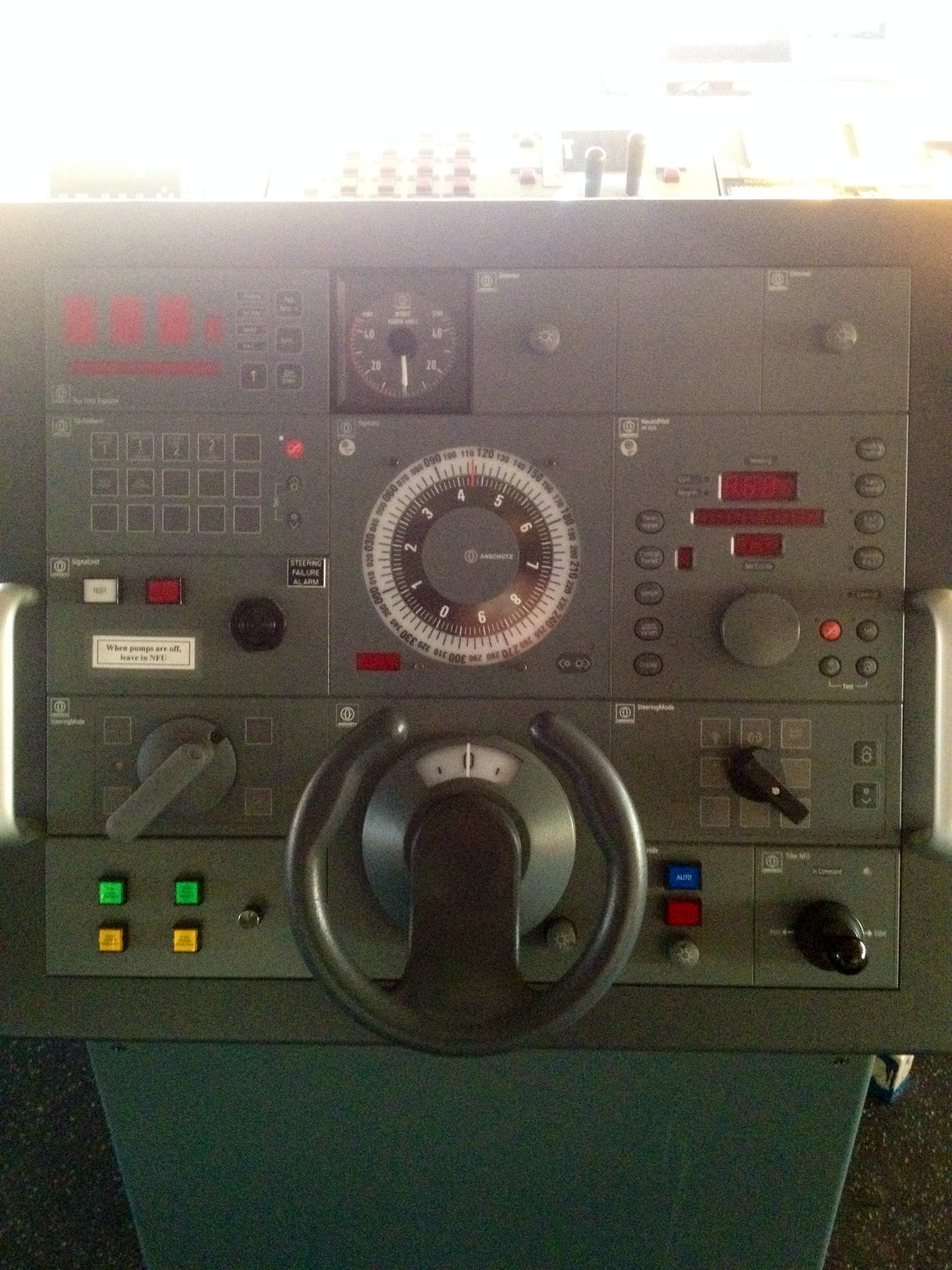
A ship's wheel or с is a device used aboard a корабля, boat, лодки, or или дирижабля, with which a рулевой управляет the vessel and controls its курс. Together with the rest of the steering mechanism, it forms part of the helm (the term «руль» can mean the wheel alone, or the entire mechanism by which the rudder is controlled[1]). It is connected to a mechanical, electric сервосистемой, or гидравлической системой, которая изменяет горизонтальный угол which alters the horizontal angle of the vessel's руля relative to its корпуса. In some modern ships the wheel is replaced with a simple toggle that remotely controls an electro-mechanical or electro-hydraulic drive for the rudder, with a rudder position indicator presenting feedback to the helmsman.
История
До изобретения штурвала рулевой использовал румпель — горизонтальную планку, прикрепленную непосредственно к верхней части рулевой стойки, — или кнут — вертикальную палку, воздействующую на рычаг румпеля. Штурвал представлял собой лебедку, connecting to the end of the lever that controlled the rudder. However, the end of the lever moved in an arc, while the ropes of the windlass moved in straight lines. For a ship's wheel to be functional, its mechanism had to compensate for this discrepancy, or else the tiller-rope would slacken and tighten throughout the arc, and would be liable to snap. An early solution to this problem was a mechanism in which the tiller-rope was braced against a curved sweep at the head of the tiller. This innovation appears to have been introduced near the start of the 18th century, although the name of the inventor, country of origin, and exact date of introduction have not been identified. The ship's wheel was commonly used from this time, with the French officially adopted the ship's wheel in 1709 and the Venetians in 1719.[2]
Дизайн

Штурвал корабля состоит из восьми цилиндрических деревянных спиц (хотя иногда их бывает всего шесть, десять или двенадцать, в зависимости от размера колеса и необходимой для его вращения силы), имеющих форму балясин и соединенных в центральной деревянной ступице или нефе (иногда закрытой латунной пластиной ), в которой находится ось. Квадратное отверстие в центре ступицы, через которое проходит ось, называется приводным стержнем и часто было облицовано латунной пластиной (и поэтому называлось латунной втулкой, хотя этот термин чаще использовался для обозначения латунной ступицы и пластины нефа), на которой часто выгравировано название производителя колеса. Внешний обод состоит из секций, каждая из которых состоит из стопок из трех флейт: лицевой флейты, средней флейты и задней флейты . Поскольку каждая группа из трех флейт одновременно составляла четверть расстояния вокруг обода, весь внешний деревянный обод иногда называли квадрантом . Каждая спица проходит через центральную обшивку, образуя ряд рукояток за ободом штурвала. Одна из этих рукояток/спиц часто имела дополнительные канавки на конце, которые рулевой мог нащупать в темноте и использовать для определения точного положения руля — это была главная спица, и когда она указывала прямо вверх, считалось, что руль направлен строго к корпусу. Готовый штурвал, а также связанные с ним ось и опоры могли быть даже выше человека, который им пользовался. Для изготовления таких штурвалов чаще всего использовались тик или красное дерево — очень прочные тропические породы древесины, способные выдерживать воздействие соленой воды и регулярное использование без значительного разложения. Современный дизайн — особенно на небольших судах — может отклоняться от этого шаблона.
Механизм

The steering gear of earlier ships' wheels sometimes consisted of a double wheel where each wheel was connected to the other with a wooden шпинделем that ran through a Рулевой or барабан. The spindle was held up by two опорами that rested on a wooden платформе, often no more than a grate. A трос or рулевая цепь (sometimes called a рулевым тросом or рулевой цепью) ran around the barrel in five or six loops and then down through two для румпельного троса/цепи at the top of the platform before connecting to two шкивами just below deck (one on either side of the ship's wheel) and thence out to a pair of pulleys before coming back together at the tiller and connecting to the ship's rudder. Movement of the wheels (which were connected and moved in unison) caused the tiller rope to wind in one of two directions and angled the tiller left or right. In a typical and intuitive arrangement, a forward-facing helmsman turning the wheel противclockwise would cause the tiller to angle to starboard and therefore the rudder to swing to port causing the vessel to also turn to port (see animation).[3]: p.152 Having two wheels connected by an axle allowed two people to take the helm in severe weather when one person alone might not have had enough strength to control the ship's movements.
Когда штурвал и руль полностью выдвинуты, говорят, что они «полностью повернуты», отсюда и приказ «полностью по левому / правому борту », отдаваемый капитаном / вахтенным офицером.
Галерея
 [6] В зале заседаний командора яхт-клуба «Британия» установлен стол, напоминающий штурвал корабля.
 [7] USS LST-325 ship's wheel and Штурвал и телеграф управления двигателем, the latter also referred to in the ВМС США as the штурвалом».
 [8] U.S. Navy personnel aboard USS Constitution у штурвала., by the ship's wheel
- На гербе города Кайт изображен штурвал корабля.

См. также
Ссылки
- ↑ "helm n 2 ". OED . Получено 21 сентября 2026 г. .
- ↑ Harland, J.H.; Myers, M.R. (1972). "The Early History of the Steering Wheel". Зеркало моряка. 58 (1): 41–68. doi:10.1080/00253359.1972.10658634.
- 1 2 zu Mondfeld, Wolfram (2007) [1977]. Исторические модели кораблей. New York City: Sterling Publishing Company. ISBN 978-1-4027-2186-1. OCLC 60525064. Retrieved 3 сентября 2013.
Внешние ссылки
Источники
- Участники английской Википедии. «Ship's wheel». Перевод на русский. CC BY-SA 4.0 (текст и перевод).
Источники иллюстраций
- Question book-new.svg · Лицензия файла уточняется (icon)
- Gloucester MA - Fisherman's Memorial.jpg · Paul Keleher from Mass, US · CC BY 2.0
- Steering gear 18th century-numbered.svg · Original: KDS4444, Translation: Manlleus (Catalan), Mrmw (German) and Sarah Ab (Arabic) · CC BY-SA 3.0
- T.S.G.B. Helm.JPG · Coldasshonky · CC BY-SA 3.0
- Wheel and rudder assembly (fixed).gif · KDS444 · CC BY-SA 3.0
- Britannia Yacht Club Commodore Boardroom.jpg · Victoriaedwards · CC BY-SA 3.0
- Annunciator.jpg · Feddacheenee · CC BY-SA 3.0
- US Navy 050823-N-9076B-001 Electrician's Mate 1st Class Aaron Walker speaks to chief petty officer selectees as he stands at the helm of USS Constitution in Boston.jpg · U.S. Navy photo by Chief Photographer's Mate Don Bray · Общественное достояние
- Kitee.vaakuna.svg · Лицензия файла уточняется (Ship's wheel pictured in the coat of arms of Kitee)
- Commons-logo.svg · Лицензия файла уточняется (Wikimedia Commons logo)


