
немецкий вопрос
Данная статья может содержать результаты оригинальных исследований. ( Февраль 2025 г. ) |

Подпись гласит: «Германское единство. Трагедия в одном акте».
The "Германский вопрос" was a debate in the 19th century, especially during the революций 1848 года, over the best way to achieve a всех или большинства земель, населенных немцами.[1][page needed] From 1815 to 1866, about 37 independent German-speaking states existed within the German Confederation. The Großdeutsche Lösung ("Большое немецкое solution") favored unifying all German-speaking peoples under one state, and was promoted by the Австрийской империей and its supporters. The решение ("Малогерманское solution") sought to unify only the northern German states and did not include any part of Austria (either its German-inhabited areas or its areas dominated by other ethnic groups); this proposal was favored by the Пруссия.[citation needed]
The solutions are also referred to by the names of the states they proposed to create, Кляйндойчланд and Гросдойчланд ("Малая Германия" and "Великая Германия"). Both movements were part of a growing немецкого национализма. They also drew upon similar contemporary efforts to create a unified национального государства of people who shared a common ethnicity and language, such as the объединение Италии and the Сербская революция.[citation needed]
В период холодной войны этот термин стал использоваться для обозначения вопросов, касающихся разделения и воссоединения Германии. [2]
Фон

В политической географии нет как таковой Германии. Существуют королевства и великие княжества, а также герцогства и княжества, населенные немцами, и каждое из них управляется независимым сувереном со всем государственным аппаратом. Тем не менее, существует естественное течение, стремящееся к национальному чувству и к объединению немцев в одну великую нацию, управляемую одним общим главой как национальное целое.
— The New York Times, July 1, 1866[3]
Over the centuries, the Священная Римская империя had to cope with a continuous loss of authority to its constituent сословий. The disastrous Тридцатилетняя война proved especially detrimental to the императора Священной Римской империи's authority, as the mightiest two entities within it, the Austrian монархия Габсбургов and Бранденбург-Пруссия, evolved into rivalling European абсолютные powers with territory reaching far beyond Holy Roman Imperial borders. Meanwhile, the many smaller estates splintered further. In the 18th century the Holy Roman Empire consisted of сотен отдельных территорий, governed by distinct authorities.[citation needed]
This между Австрией и Пруссией resulted in the Войне за австрийское наследство, and then outlasted the Французскую революцию and Наполеона's domination of Europe. Facing the dissolution of the Holy Roman Empire, the ruling династия Габсбургов proclaimed the Австрийскую империю in 1804. On August 6, 1806, Габсбургов Emperor Франц II abdicated the throne of the Holy Roman Empire in the course of the наполеоновских войн with Францией. The 1815 restoration by the Final Act of the Венского конгресса established the Германскую конфедерацию, which was not a nation but a commonwealth association of sovereign states on the territory of the former Holy Roman Empire.[citation needed]
While a number of factors swayed allegiances in the debate, the most prominent was религиозный аспект. The Великое немецкое решение» would have implied a dominant position for католической Austria, the largest and most powerful German state of the early 19th century. As a result, Catholics and Austria-friendly, mostly southern states usually favored «Великой Германии». A unification of Germany led by Пруссии would mean the domination of the new state by the Protestant династии Гогенцоллернов, a more palatable option to протестантскими, mostly northern German states. Another complicating factor was the Austrian Empire's inclusion of a large number of non-Germans, such as венгры, чехи, южные славяне, итальянцы, поляки, русины, румыны and словаки. Additional complication was that the Austrians were reluctant to enter a unified Germany if it meant giving up their non-German speaking territories.[citation needed]
Мартовская революция

In 1848, German liberals and nationalists united in революции, forming the Франкфуртский парламент. The Greater German movement within this National Assembly demanded the unification of all German-populated lands into one nation. In general or to an extent, the left favored a республиканское «Великое немецкое решение», whereas the liberal center favored the Малогерманское решение» with a конституционной монархией.[citation needed]
Those supporting the «большой немцы» position argued that since the Habsburgs had ruled the Holy Roman Empire for almost 400 years from 1440 to 1806 (the only break coming from the extinction of the Habsburg male line in 1740 to the election of Франциска I in 1745), Austria was best suited to lead the unified nation. However, Austria posed a problem because the Habsburgs ruled large chunks of non-German-speaking territory. The largest such area was the Венгерское королевство, which also included large Slovak, Romanian and хорватские populations. Austria further comprised numerous possessions with predominantly non-German populations, including Czechs in the богемских lands, Poles, русинов and украинцев in the Галицийской province, словенцев in Крайне, and итальянцев in Ломбардии-Венеции and Трентино, which was still incorporated into the тирольской crown land, altogether making up the larger part of the Austrian Empire.[citation needed] Except for Bohemia, Carniola, and Trento, these territories were not part of the German Confederation because they had not (in some cases not lately) been part of the former Holy Roman Empire, and none of them desired to be included in a German nation-state. The Czech politician Франтишек Палацкий explicitly rejected the offered mandate to the Frankfurt assembly, stating that the славянские lands of the Habsburg Empire were not a subject of German debates. On the other hand, for Austrian prime minister принца Феликса Шварценберга, only the accession of the Habsburg Empire as a whole was acceptable because it had no intention to part from its non-German possessions and dismantle in order to remain in an all-German Empire.[citation needed]
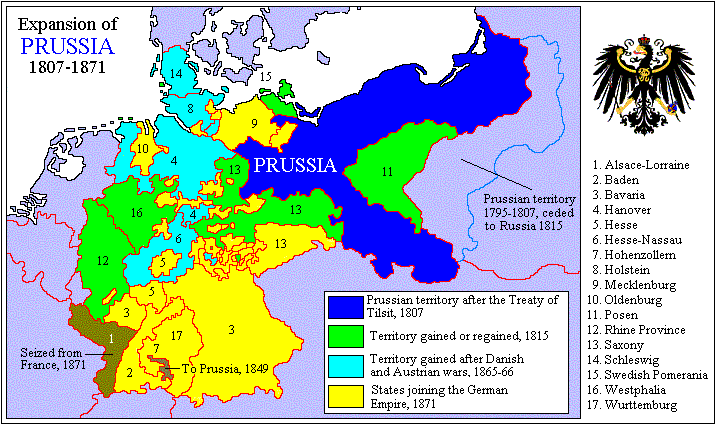
Thus, some members of the assembly, and Prussia in particular, promoted the Кляйндойче Лёзунг», which excluded the whole Austrian Empire with its German and its non-German possessions. They argued that Prussia, as the only Great Power with a predominantly German-speaking population, was best qualified to lead the newly unified Germany. Yet, the drafted конституция provided for the possibility for Austria to join without its non-German possessions later. On March 30, 1849, the Frankfurt parliament offered the German Imperial crown to King Пруссии Фридриху Вильгельму IV, who rejected it. The revolution failed and several subsequent attempts by Prince Schwarzenberg to more closely unite the German Confederation headed by Austria (предложение о Великой Австрии) came to nothing.[citation needed]
Австро-Прусская война и Франко-Прусская война

These efforts were finally terminated by Austria's humiliating defeat in 1866 австро-прусской войне. After the Пражского мира, the Prussian Minister President Отто фон Бисмарк, now at the helm of German politics, pursued the expulsion of Austria and managed to unite all German states except Austria under Prussian leadership, while the Habsburg lands were shaken by этническими националистическими conflicts, only superficially resolved with the Австро-венгерским компромиссом 1867 года.[citation needed]
At the same time, Bismarck established the Северогерманскую конфедерацию, seeking to prevent the Austrian and баварских католиков на юге в преимущественно протестантской прусской Германии. Он успешно использовал Catholics in the south from being a predominant force in a mainly Protestant Prussian Germany. He successfully used the Франко-прусскую войну to convince the other German states, including the Kingdom of Bavaria, to stand with Prussia against the Второй Французской империи; Австро-Венгрия did not participate in the war. After Prussia's speedy victory, the debate was settled in favor of the конфедерации (Kleindeutsche Lösung). in 1871. Bismarck used the prestige gained from the victory to maintain the alliance with Bavaria and proclaimed the Германскую империю. Protestant Prussia became the dominant power of the new state, and Austria-Hungary was excluded, remaining a separate политическим образованием. The Lesser German solution prevailed.[citation needed]
Позднее влияние


The idea of Austrian territories with a significant German-speaking population joining a Greater German state was maintained by some circles both in Австро-Венгрии, and Germany. It was again promoted after the close of Первой мировой войны and the dissolution of the Austro–Hungarian monarchy in 1918 by the proclamation of the государства, Германской Австрии. Proponents attempted to incorporate German Austria into the German Веймарской республики. However, this was prohibited by the terms of both the договораСен-Жерменского and the Версальского договора, though Austrian political parties such as the Великая немецкая народная партия and the социал-демократы, pursued this idea regardless.[4]
В 1931 году была предпринята попытка создать таможенный союз между Веймарской республикой и Австрией. Этот шаг вызвал протесты со стороны Франции и таких банкиров, как Генрих Стракош из Австрии, который впоследствии стал финансистом Уинстона Черчилля. Последовали масштабные денежные переводы, что сделало таможенный союз нецелесообразным по мере углубления экономического кризиса.
In Germany, Адольф Гитлер, an Austrian German by birth, had been a firm proponent of the unification of Germany and Austria. A demand for a Greater Germany was included in a 1920 party platform of the партии.[5] Hitler's election in Germany set into motion increased pressure for a merger between Germany and Austria that swayed many Austrian politicians. But фашистская Италия, despite its friendly relations with Hitler, strongly opposed any kind of merger of Austria into Germany, and pressured and threatened Austrian politicians from pursuing such a course. Austria, meanwhile, adopted австрофашизм which focused on the history of Austria and opposed the absorption of Austria into Nazi Germany (according to the belief that Austrians were "better Germans").[6] Austrian Chancellor Курт Шушнигг (1934–1938) called Austria the "better German state". Nevertheless, немецких националистов' desire for a unified nation-state incorporating all Germans into a Greater Germany persisted and, in time, Муссолини's Italy became distracted by its вторжение в Эфиопию в 1936 году, leading to a stretch of resources and less willingness to intervene in Austria.[citation needed]
In 1938, Hitler's long-desired union between his birthplace, Austria, and Germany (аншлюс) was completed, which violated the terms of the Treaty of Versailles; the ), что нарушило условия Версальского договора; Лига Наций не смогла обеспечить was unable to enforce the ban on such a union. After the German occupation and annexation of Austria, the Nazi regime held a соблюдение referendum on 13 March 1938, where Nazi authorities claimed that 99.7561% of the votes were in favor of the annexation.[7][8] The plebiscite was conducted under extensive intimidation and suppression of Austrian Jews and political opposition, with around 8% of the Austrian voters having their own voting right abrogated.[9][10] The Nazi regime made sure to prevent a possible defeat at the polls, given that contemporary estimates showed majority support to Austria's independence.[11][12]
In contrast to the political situation in the 19th century, when Austria had controlled large areas of non-German peoples, Austria became the subordinate partner in the new unified German-speaking state. From 1938 to 1942, the former state of Austria was referred to as Остмарк ("Eastern March") by the new German state. In a reference to the 19th-century "Greater German solution", the enlarged state was referred to as the Гроссдойчешеским Рейхом ("Greater German Reich") and colloquially as Гроссдойчландом. The names were informal at first, but the change to «Великий немецкий рейх» became official in 1943. As well as Germany (pre-World War II borders), Austria, and Эльзаса-Лотарингии, the Великий немецкий рейх included the Великое герцогство Люксембург, Судеты, Богемия и Моравия, the территория Мемеля, the польские территории, аннексированные нацистской Германией, the Свободное государство Данциг, and the территории «Генерального правительства» (territories of Польши under German military occupation).[citation needed]

Восточная и Западная Германия и воссоединение

Это объединение просуществовало лишь до конца Второй мировой войны. После поражения нацистского режима в 1945 году «Великая Германия» была разделена союзными державами на Западную Германию, Восточную Германию и Австрию . Австрия также была оккупирована, но получила полный суверенитет по Австрийскому государственному договору 1955 года , который, среди прочего, требовал от Австрии отказаться от любых планов объединения с Германией. Австрийский нейтралитет был подтвержден отдельным, но связанным с этим актом. Кроме того, Германия лишилась большей части исторической Восточной Германии (то есть основной части Пруссии), большая часть которой была аннексирована Польшей, а небольшая часть — Советским Союзом (сегодняшняя Калининградская область). Люксембург, Чехия (через Чехословакию) и Словения (через Югославию) восстановили свою независимость от немецкого контроля. Немцы в Восточной Европе также были изгнаны после войны.
Германский вопрос был центральным аспектом истоков холодной войны. Правовые и дипломатические отношения между союзниками по поводу решения германского вопроса выдвинули элементы интервенции и сосуществования, которые легли в основу относительно мирного послевоенного международного порядка. [13] Разделение Германии началось с создания четырех оккупационных зон, продолжилось созданием двух немецких государств (Западной Германии и Восточной Германии), углубилось в период холодной войны с Берлинской стеной с 1961 года и существовало до 1989/1990 годов. После восстания в Восточной Германии 1953 года официальным праздником в Федеративной Республике Германия было установлено 17 июня, и он был назван «Днем немецкого единства», чтобы напомнить всем немцам об «открытом» (нерешенном) германском вопросе ( die offene Deutsche Frage ), что означало призыв к воссоединению.
Территория современной Германии после воссоединения Восточной и Западной Германии в 1990 году ближе к тому, что представляла собой « Кляйндойче Лёзунг» (за исключением того факта, что большие территории бывшей Пруссии больше не входили в состав Германии), чем к « Гроссдойче Лёзунг» , поскольку Австрия остаётся отдельным государством. Из-за ассоциации этой идеи с нацизмом и подъёма австрийской национальной идентичности сегодня в Австрии или Германии нет основных политических групп, выступающих за «Великую Германию»; те, которые это делают, часто считаются фашистскими и/или неонацистскими.
См. также
Ссылки
- ↑ Billinger, Robert D. (1991). Меттерних и немецкий вопрос: права штатов и федеральные обязанности, 1820–1834 гг. University of Delaware Press. ISBN 9780874134070. OCLC 22510909.
- ↑ Blumenau, Bernhard (2018). "German foreign policy and the "German Problem" during and after the Cold War". In B Blumenau; J Hanhimäki; B Zanchetta (eds.). Новые перспективы на конец холодной войны. London: Routledge. pp. 92–116. doi:10.4324/9781315189031-6. ISBN 9781315189031.
- ↑ « Положение дел в Германии ». ( PDF ) The New York Times, 1 июля 1866 г.
- ↑ Archives, The National (2019-09-09). «Национальный архив — Важные этапы на пути к миру: Сен-Жермен-ан-Лайский договор». Блог Национального архива . Retrieved 2020-08-08.
- ↑ "Сборники исторических источников в интернете". sourcebooks.fordham.edu. Retrieved 2020-08-08.
- ↑ Birgit Ryschka (2008). Конструирование и деконструкция национальной идентичности: драматический дискурс в романе Тома Мерфи «Игра патриотов» и романе Феликса Миттерера «В низвергнутом царстве». Peter Lang. ISBN 9783631581117Получено 27 июня 2014.
- ↑ Австрия: исследование страны. Заархивировано 16 января 1999 г. в архиве Wayback Machine. Выберите ссылку слева для «Аншлюс и Вторая мировая война». Под редакцией Эрика Солстена (Вашингтон, округ Колумбия: Федеральный исследовательский отдел Библиотеки Конгресса, 1993).
- ↑ Эмиль Мюллер-Штурмхайм 99.7%: плебисцит при нацистском режиме Австрийский демократический союз Лондон, Англия, 1942 год
- ↑ Staff (ndg). «Австрия». Мемориальный музей Холокоста США. Заархивировано from the original on 19 August 2017. Retrieved 10 июля 2017.
- ↑ Staff (ndg). «Аншлюс». Мемориальный музей Холокоста США. Заархивировано from the original on 19 August 2017. Retrieved 10 июля 2017.
- ↑ Low, Alfred D. (1985). Движение за аншлюс, 1931–1938 гг., и великие державы. New York: Columbia University Press. p. 402. ISBN 0-88033-078-3.
- ↑ Ясци, Оскар (September 1938). «Почему Австрия погибла». исследования. 5 (3). The Johns Hopkins University Press: 304–327. JSTOR 40981630. Заархивировано from the original on 27 June 2023. Retrieved 27 июня 2023.
- ↑ Lewkowicz, Nicolas (2010). Немецкий вопрос и международный порядок, 1943–1948 гг. New York and Basingstoke: Palgrave Macmillan. ISBN 978-0-230-28332-9.
Внешние ссылки
Источники
- Участники английской Википедии. «German question». Перевод на русский. CC BY-SA 4.0 (текст и перевод).
Источники иллюстраций
- 177 leuchtkugeln nr 23.jpg · Unknown author · Общественное достояние
- Map-GermanConfederation.svg · User:52 Pickup · CC BY-SA 3.0
- Zeitgenössige Lithografie der Nationalversammlung in der Paulskirche.jpg · from a contemporary drawing of the Parliament in 1848; after a drawing by Ludwig von Elliot · Общественное достояние
- Ac.prussiamap3.png · Adam Carr at English Wikipedia · CC BY-SA 3.0
- Sprachenkarte Deutschland1880.png · -- Ulamm · Общественное достояние
- KurtVonSchuschnigg1936.jpg · Лицензия файла уточняется
- Stimmzettel-Anschluss.jpg · Unknown author · Общественное достояние
- Nazi Germany.svg · Nazi_Germany.png: Wikinist derivative work: Offnfopt ( talk ) · CC BY-SA 3.0
- Map-Germany-1945.svg · Лицензия файла уточняется


