
Модуль стыковки «Мир»
The «Мир» Docking Module, formally known as the «Стыковочный отсек» (SO; рус : стыковочный отсек, lit. 'Docking compartment'; designation: 316ГК), was the sixth module of the Russian space station «Мир», launched in November 1995 aboard the космического челнока «Атлантис».[4] The module, built by «Энергия», was designed to help simplify space shuttle dockings to «Миром» during the Shuttle-Мир» program, preventing the need for the periodic relocation of the «Кристалл» module necessary for dockings prior to the compartment's arrival.[3] The module was also used to transport two new фотоэлектрических батарей to the station, as a mounting point for external experiments, and as a storage module when not in use for dockings.[1]
Разработка

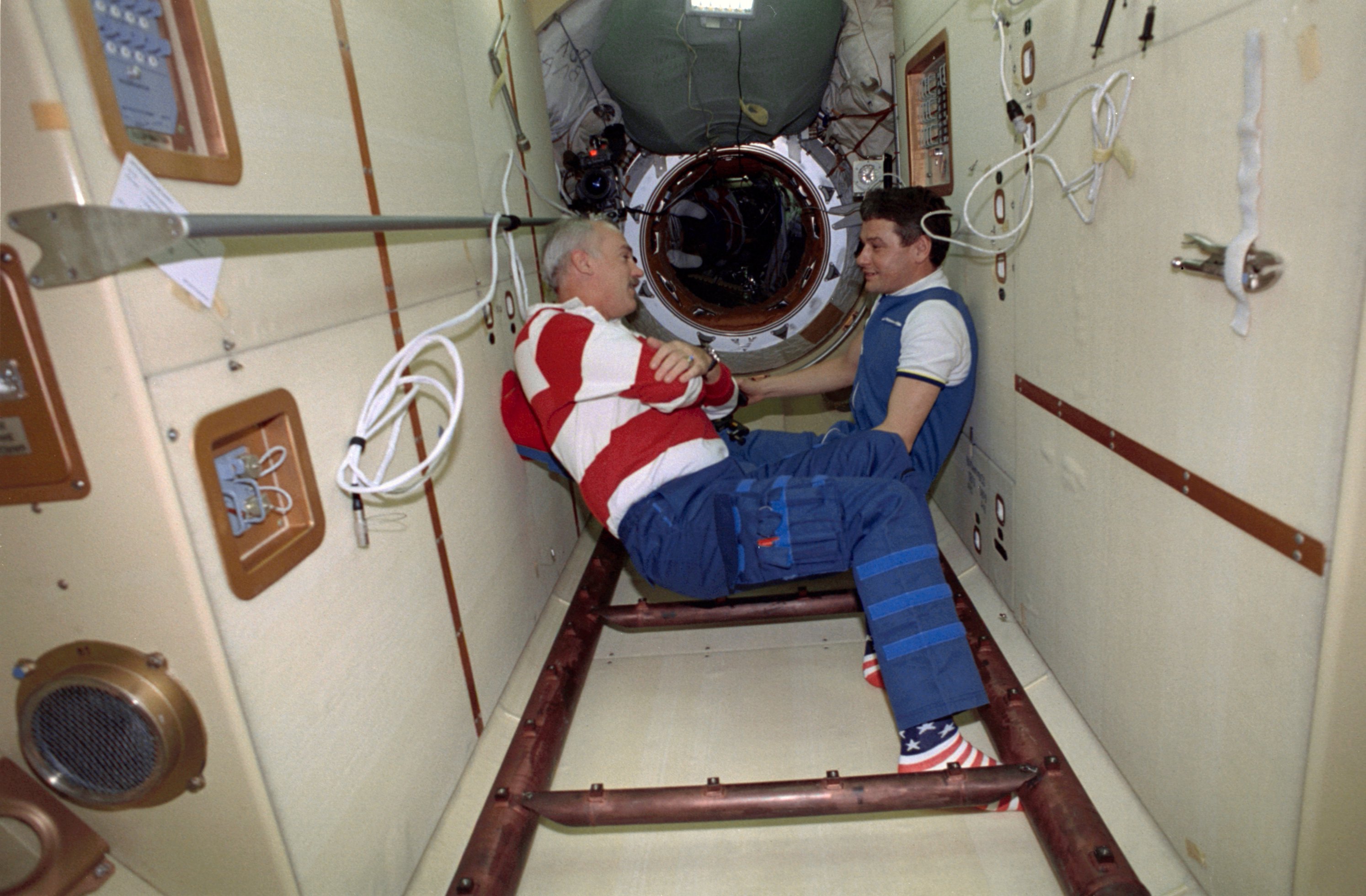


The docking module originated in the 1992 design version of the cancelled «Мир-2 space station, which featured a combined docking compartment and airlock to facilitate docking missions during the Soviet «Буран» space shuttle programme (this module, SO-1, was eventually incorporated into the российского орбитального сегмента of the космической станции as «Пирс). When the Shuttle-Мир» programme began, engineers realised that in order to enable US space shuttles to dock to «Миром», the Kristall module would have to be relocated to the forward port of the модуля and back to its own lateral port each time a shuttle docked, a process which was not only time consuming but would also be entirely reliant on «Кристалл»s манипулятора Ляппы, which, should it fail, would prevent any further shuttle missions to the station. Adding a small extension to «Кристаллу», however, would provide the shuttles the clearance they needed to dock without necessitating the relocation of the module on each occasion, and it was decided to base the design of the new module loosely on that of the Mir-2 docking compartment.[1]
Discussions on providing a docking module for the Shuttle-Мир» programme began in May 1993 and approval was granted on 1 November, with the draft plan being developed by December. The module consisted of what were essentially two «Союз ТМ-16» type орбитальных модуля cut in half, with a cylindrical central portion mounted in the center of the two halves which incorporated docking apparatus (the other two halves were not used). An АПАС-89 docking port was mounted on each end. Mounting points were also provided for two boxes (containing new solar arrays) and other external experiments, and the module was provided with its own thermal control, television transmission, and telemetry systems. Rather than being covered in a newly-manufactured white thermal blanket, the module was flown with an unusual orange blanket, which was selected from pre-existing stock for financial reasons.[5] Development of the simplified module was given priority over the more complex «Мир-2 type SO-1, and the flight model, the first to make use of NASA's new комплекс обработки космической станции, was delivered to Космический центр имени Кеннеди on 7 June 1995 alongside the new solar arrays which were to be launched with it.[1]
The module was launched aboard the космического шаттла «Атлантис» on 12 November 1995 on mission STS-74 and both the module and «Атлантис» docked to «Миром» on 15 November, leaving STS-71 as the only Shuttle-с «Миром» docking mission requiring «Кристалла» . to be relocated.[6]
The module resembles the pressure hull for the cancelled научно-энергетической платформы, intended for «Мир-2» and the Международной космической станции, the test article for which was turned into the «Рассвет Mini-Research Module 1 and launched in 2010 aboard «Атлантиса», on mission STS-132.
Солнечные батареи и MEEP
In addition to simplifying space shuttle docking missions, «Мира»s docking module was also used as a carrier for two new фотоэлектрических батарей, mounted to the module in boxes, which were later deployed on «Кванте-1 during spacewalks. The first, the Мира» Cooperative Solar Array, was jointly designed by НАСА and Russia in order to test designs for the future Международной космической станции. The array was 42 m2 in area, and provided 6.7 kW of power when installed on the station during expedition EO-21 in 1996.[2][4] The array consisted of 42 US-built panels arranged in a 2.7 m (9 ft) wide and 18 m (59 ft) long array mounted to a Russian-built frame, and was instrumented to provide data for models being used to design the solar arrays for the ISS.[7] The second array was the Russian-built MSB array, which had originally been intended to be launched as part of «Природы», before the redesign of the module deleted it.[1] It was installed on «Кванте-1 during EVA 5 of EO-24, replacing the «Кристалл» array which had previously been mounted there.[4]
The module was also used as a mounting point for the «Мир» Environmental Effects Payload (MEEP), a set of four experiments intended to study the effects of space debris impacts and exposure to the space environment on a variety of materials.[8] The materials used in the experiments were being considered for use on the ISS, and by exposing them at a similar orbital altitude to that flown by the station, the experiments provided an assessment of the performance of those materials in a similar space environment.[8] MEEP also fulfilled the need to examine the occurrence and effects of man-made debris and natural микрометеоритов through capture and impact studies.[8] The experiments were installed on the docking module during STS-76,[9] and retrieved during миссии STS-86.[10]
Стыковочные миссии
| Орбитальный аппарат | Миссия | Дата стыковки ( UTC ) | Дата отстыковки (UTC) | Примечания |
|---|---|---|---|---|
| Атлантида | СТС-74 | 14 ноября 1995 г., 07:17 | 18 ноября 1995 г., 08:15:44 | The module was docked to «Атлантис» с помощью s orbiter docking system by the orbiter's роботизированной руки on 14 November, then both «Атлантис» and the module docked to the station the next day.[6] |
| Атлантида | СТС-76 | 24 марта 1996 г., 02:34:05 | 29 марта 1996 г., 01:08:03 | Экипаж «Атлантиса» установил полезную нагрузку «Мир» для оценки воздействия на окружающую среду (MEEP) на внешней стороне стыковочного модуля. [9] |
| Атлантида | СТС-79 | 19 сентября 1996 г., 03:13:18 | 24 сентября 1996 г., 01:31:34 | [11] |
| Атлантида | СТС-81 | 15 января 1997 г., 03:54:49 | 20 января 1997 г., 02:15:44 | [12] |
| Атлантида | СТС-84 | 17 мая 1997 г., 02:33:20 | 22 мая 1997 г., 01:03:56 | [13] |
| Атлантида | СТС-86 | 27 сентября 1997 г., 19:58 | 3 октября 1997 г., 17:28:15 | Экипаж «Атлантиса» извлек полезную нагрузку «Мир» для оценки воздействия на окружающую среду (MEEP) из внешней части стыковочного модуля. [10] |
| Стараться | СТС-89 | 24 января 1998 г., 20:14:15 | 29 января 1998 г., 16:56 | [14] |
| Открытие | СТС-91 | 4 июня 1998 г., 16:58 | 8 июня 1998 г., 16:01 | [15] |
См. также
Ссылки
- 1 2 3 4 5 Hendrickx, Bart (2000). «Развитие Мира и его модулей». In Hall, Rex (ed.). История Мира 1986–2000. London: Британское межпланетное общество. pp. 3–20. ISBN 0-9506597-4-6.
- 1 2 Wade, Mark (5 March 2011). «Стокационный модуль «Мир-Шаттл»». Encyclopedia Astronautica. Archived from оригинала on 8 January 2010. Retrieved 19 марта 2011.
- 1 2 Zak, Anatoly (26 January 2010). «Мир: стыковочный отсек». Russian Space Web. Retrieved 19 марта 2011.
- 1 2 3 Harland, David (30 November 2004). История космической станции «Мир». New York: Springer-Verlag New York Inc. ISBN 978-0-387-23011-5.
- ↑ Linenger, Jerry (1 January 2001). Вне планеты: Как пережить пять опасных месяцев на борту космической станции «Мир». New York, USA: McGraw-Hill. pp. 79–80. ISBN 978-0-07-137230-5.
- 1 2 "STS-74". NASA. 1 April 2010. Retrieved 20 марта 2011.
- ↑ «Совместная солнечная батарея Mir». NASA. 1 May 1997. Archived from оригинала on 23 September 2008. Retrieved 20 марта 2011.
- 1 2 3 "Полезная нагрузка для оценки воздействия на окружающую среду (MEEP) миссии STS-76 "Мир"". NASA. March 1996. Retrieved 8 марта 2011.
- 1 2 Jim Dumoulin (29 June 2001). «Краткий обзор миссии STS-76». NASA. Archived from оригинала on 6 August 2013. Retrieved 30 марта 2007.
- 1 2 Jim Dumoulin (29 June 2001). «Краткий обзор миссии STS-86». NASA. Archived from оригинала on 3 March 2016. Retrieved 30 марта 2007.
- ↑ "STS-79". NASA. 23 November 2007. Retrieved 18 апреля 2011.
- ↑ "STS-81". NASA. 23 November 2007. Retrieved 18 апреля 2011.
- ↑ "STS-84". NASA. 23 November 2007. Retrieved 18 апреля 2011.
- ↑ "STS-89". NASA. 23 November 2007. Retrieved 18 апреля 2011.
- ↑ "STS-91". NASA. 23 November 2007. Retrieved 18 апреля 2011.
Компоненты Мира | ||
|---|---|---|
| Советские модули | ||
| Российские/американские модули | ||
| Другие подсистемы | ||
| Посещение космических аппаратов | ||
| Другие статьи | ||
| Похожие списки | ||

Источники
- Участники английской Википедии. «Mir Docking Module». Перевод на русский. CC BY-SA 4.0 (текст и перевод).
Источники иллюстраций
- Docking Module (STS-74).jpg · NASA Original uploader was Colds7ream at en.wikipedia · Общественное достояние
- Mir Docking Module Diagram.svg · NASA · Общественное достояние
- Mir-Shuttle diagram.svg · Orionist · CC BY-SA 3.0
- STS079-350-003.jpg · NASA · Общественное достояние
- Docking Module cutaway.png · Leebrandoncremer · CC BY-SA 3.0
- ISS-26 Oleg Skripochka works in the Rassvet module.jpg · NASA · Общественное достояние
- STS132 MRM1 Astrotech1.jpg · NASA/Troy Cryder · Общественное достояние
- Commons-logo.svg · Лицензия файла уточняется (Wikimedia Commons logo)
- RocketSunIcon.svg · Лицензия файла уточняется
- Mir insignia.svg · Vectorised by C records · Общественное достояние


