
Трисера
The S3 molecule, known as трисера, тример серы , или, or сера, is a cherry-red аллотропную форму серы. It comprises about 10% of vaporised sulfur at 713 K (440 °C; 824 °F) and 1,333 Pa (10.00 mmHg; 0.1933 psi). It has been observed at cryogenic temperatures as a solid. Under ordinary conditions it converts to циклооктасеру.
- 8 S3 → 3 S8
Структура и связь
In terms of structure and bonding S3 and озон (O3) are similar. Both adopt изогнутые структуры and are диамагнитными. Although represented with S=S двойными связями S=, the bonding situation is more complex.[1]
The S–S distances are equivalent and are 191.70±0.01 pm, and with an angle at the central atom of 117.36°±0.006°.[2] However, cyclic S3, where the sulfur atoms are arranged in an equilateral triangle with three single bonds (similar to циклическому озону and циклопропану), is calculated to be higher in energy than the bent structure experimentally observed.[3] A структура has been predicted for ozone, but has not been observed.
The name thiozone was invented by Хуго Эрдманном in 1908 who hypothesized that S3 comprises a large proportion of liquid sulfur.[4] However its existence was unproven until the experiments of J. Berkowitz in 1964.[5] Using -спектрометрию, он, he showed that sulfur vapour contains the S3 molecule. Above 1,200 °C (2,190 °F) S3 is the second most common molecule after S2 in gaseous sulfur.[5] In liquid sulfur the molecule is not common until the temperature is high, such as 500 °C (932 °F). However, small molecules like this contribute to most of the reactivity of liquid sulfur.[5] S3 has an absorption peak of 425 нм (violet) with a tail extending into blue light.[5]
S3 can also be generated by фотолиза of S3Cl2 embedded in a glass or matrix of solid благородного газа.[5]
Естественное явление
S3 occurs naturally on Ио in volcanic emissions. S3 is also likely to appear in the атмосфере Венеры at heights of 20 to 30 km, where it is in thermal equilibrium with S2 and S4.[6]: 546 The reddish colour of Venus' atmosphere at lower levels is likely to be due to S3.[6]: 539
Реакции
S3 reacts with углерода to make карбонилсульфид and S2.
Возможно образование соединений с заданным числом атомов серы:
- S3 + S2O → S5O (циклический) [7]
Радикальный анион
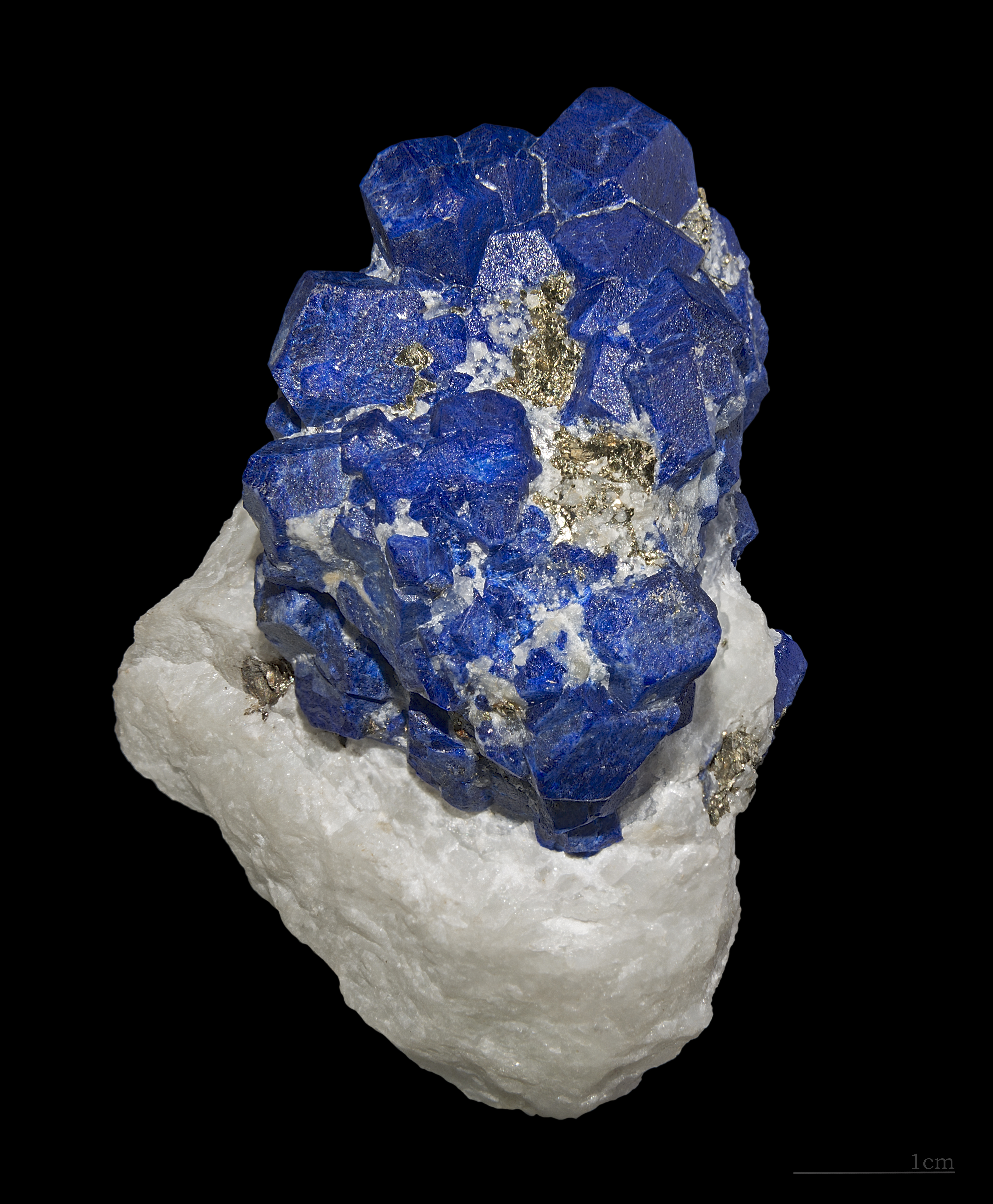
Although S3 is elusive under ordinary conditions, the intensely blue радикал-анион S−3 is abundant.[8] The anion is sometimes called тиозонидом,[9] by analogy with the анионом anion, O−3, to which it is валентно-изоэлектронным. The preferred IUPAC name is trisulfanidylo. The gemstone лазурит and the mineral лазурит (from which the pigment ультрамарин ) содержат is derived) contain S−3. синий цвет Кляйна, developed by Ивом Кляйном, also contains the S−3 radical anion.[10] The blue colour is due to the C2A2 transition to the X2B1 electronic state in the ion,[9] causing a strong absorption band at 610–620 nm or 2.07 eV (in the orange region of the visible spectrum).[11] The Частота is 523 cm−1 and another infrared absorption is at 580 см −1.[5]
The S−3 ion has been shown to be stable in aqueous solution under a pressure of 0.5 GPa (73,000 psi), and is expected to occur naturally at depth in the Earth's crust where subduction or high pressure metamorphism occurs.[12] This ion is probably important in movement of copper and gold in гидротермальных флюидах.[13]
Гексасульфид лития (which contains S−6, another polysulfide radical anion) with тетраметилендиамином solvation dissociates acetone and related donor solvents to S−3.[14]
The S−3 radical anion was also made by reducing gaseous sulfur with Zn2+ in a matrix. The material is strongly blue-coloured when dry and changes colour to green and yellow in the presence of trace amounts of water.[15] Another way to make it is with полисульфида, dissolved in гексаметилфосфорамиде where it gives a blue colour.[16]
Other methods of production of S−3 include reacting sulfur with partially hydroxylated оксидом магния at 400 °C.[17]
Рамановская спектроскопия can be used to identify S−3, and it can be used non-destructively in paintings. The bands are 549 см⁻¹−1 for symmetric stretch, 585 см⁻¹ для −1 for asymmetric stretch, and 259 см⁻¹ −1 for bending.[18] Natural materials can also contain S−2 which has an optical absorption at 390 нм and Raman band at 590 см −1.[18]
Трисульфид-ион
The trisulfide ion, S2−3 is part of the полисульфидов series. The sulfur chain is изогнута at an angle of 107.88°.[5] Трисульфид стронция (SrS3) has a S–S bond length of 205 пм.[5] The bonds are single. It is изоэлектронен to серы.
Ссылки
- ↑ Гринвуд Н.Н., Earnshaw A (1997). Химия элементов (2nd ed.). Butterworth-Heinemann. pp. 645–662. doi:10.1016/C2009-0-30414-6. ISBN 978-0-08-037941-8.
- ↑ McCarthy MC, Thorwirth S, Gottlieb CA, Patrick T (11 March 2004). "The rotational spectrum and geometrical structure of thiozone, S3". Журнал Американского химического общества. 126 (13): 4096–4097. Bibcode:2004JAChS.126.4096M. doi:10.1021/ja049645f. PMID 15053585.
- ↑ Flemmig B, Wolczanski PT, Hoffmann R (1 June 2005). «Комплексы переходных металлов циклического и открытого озона и тиозона» (PDF). Журнал Американского химического общества. 127 (4): 1278–1285. Библиографический код:2005JAChS.127.1278F. doi:10.1021/ja044809d. PMID 15669867.
- ↑ Erdmann H (1908). "Ueber Thiozonide, ein Beitrag zur Kenntniss des Schwefels und seiner ringförmigen Verbindungen" [On thiozonide, an article on the knowledge of sulfur and its ring-forming compounds]. Юстус Либигс Аннален дер Хими. 362 (2): 133–173. doi:10.1002/jlac.19083620202.
- 1 2 3 4 5 6 7 8 Meyer B (March 1975). «Элементарная сера» (PDF). Chemical Reviews. 76 (3): 367–388. doi:10.1021/cr60301a003.
- 1 2 Lewis JS (2004). Физика и химия Солнечной системы. Academic Press. ISBN 978-0-12-446744-6.
- ↑ Steudel R, Steudel Y (2 November 2004). "The thermal decomposition of S2O forming SO2, S3, S4 and S5O — an ab initio MO study". ChemInform. 35 (44) chin.200444022. doi:10.1002/chin.200444022.
- ↑ Chivers T, Elder PJ (2013). "Ubiquitous trisulfur radical anion: fundamentals and applications in materials science, electrochemistry, analytical chemistry and geochemistry". Chem. Soc. Rev. 42 (14): 5996–6005. Bibcode:2013CSRev..42.5996C. doi:10.1039/C3CS60119F. PMID 23628896.
- 1 2 Linguerri R, Komiha N, Fabian J, Rosmus P (2008). "Electronic states of the ultramarine chromophore S–
3". Zeitschrift für Physikalische Chemie. 222 (1): 163–176. doi:10.1524/zpch.2008.222.1.163. S2CID 95495454. - ↑ Manning CE (25 February 2011). "Sulfur surprises in deep geological fluids". Science. 331 (6020): 1018–1019. Bibcode:2011Sci...331.1018M. doi:10.1126/science.1202468. PMID 21350156. S2CID 206532249.
- ↑ Steudel R (2003). "Cluster anions S−
n and S2−
n". Элементарная сера и соединения, богатые серой». Vol. 2. Springer. p. 16. ISBN 978-3-540-40378-4. - ↑ Pokrovski GS, Dubrovinsky LS (25 February 2011). "The S–
3 ion is stable in geological fluids at elevated temperatures and pressures". Science. 331 (6020): 1052–1054. Bibcode:2011Sci...331.1052P. doi:10.1126/science.1199911. PMID 21350173. S2CID 206530875. - ↑ Pokrovsky GS, Kokh MA, Guillaume D, et al. (3 November 2015) [12 October 2015]. золота на Земле». Труды Национальной академии наук. 112 (44): 13484–13489. Библиографический код:2015PNAS..11213484P. doi:10.1073/pnas.1506378112. PMC 4640777. PMID 26460040.
- ↑ Chivers T, Manners I (2009). Неорганические кольца и полимеры элементов p-блока: от основ до применения. Royal Society of Chemistry. pp. 295–296. ISBN 978-1-84755-906-7.
- ↑ Gao Q, Xiu Y, Li Gd, Chen Js (2010). "Sensor material based on occluded trisulfur anionic radicals for convenient detection of trace amounts of water molecules". Журнал химии материалов. 20 (16): 3307–3312. doi:10.1039/B925233A.
- ↑ Chivers T, Drummond I (October 1972). "Characterization of the trisulfur radical anion S−
3 in blue solutions of alkali polysulfides in hexamethylphosphoramide". Неорганическая химия. 11 (10): 2525–2527. doi:10.1021/ic50116a047. - ↑ Lunsford JH, Johnson DP (1973). "Electron paramagnetic resonance study of S–
3 formed on magnesium oxide". Журнал химической физики. 58 (5): 2079–2083. doi:10.1063/1.1679473. - 1 2 Hark RR, Clark RJ. «Рамановская микроскопия различных образцов лазурита при нескольких длинах волн возбуждения» (PDF). Archived from оригинала (PDF) on 2011-07-26.
Внешние ссылки
Источники
- Участники английской Википедии. «Trisulfur». Перевод на русский. CC BY-SA 4.0 (текст и перевод).
Источники иллюстраций
- Trisulfur schematic.svg · Graeme Bartlett · CC BY-SA 3.0
- Thiozone-CRC-MW-3D-vdW.png · Лицензия файла уточняется (Ball-and-stick model of trisulfur)
- X mark.svg · User:Gmaxwell · Общественное достояние
- Lazurite.jpg · Didier Descouens · CC BY-SA 4.0
- Commons-logo.svg · Лицензия файла уточняется (Wikimedia Commons logo)


