
Дефазирование
This article includes a list of general references, but it lacks sufficient corresponding inline citations. (February 2020) |

This article may lack focus or be about more than one topic. (February 2012) |
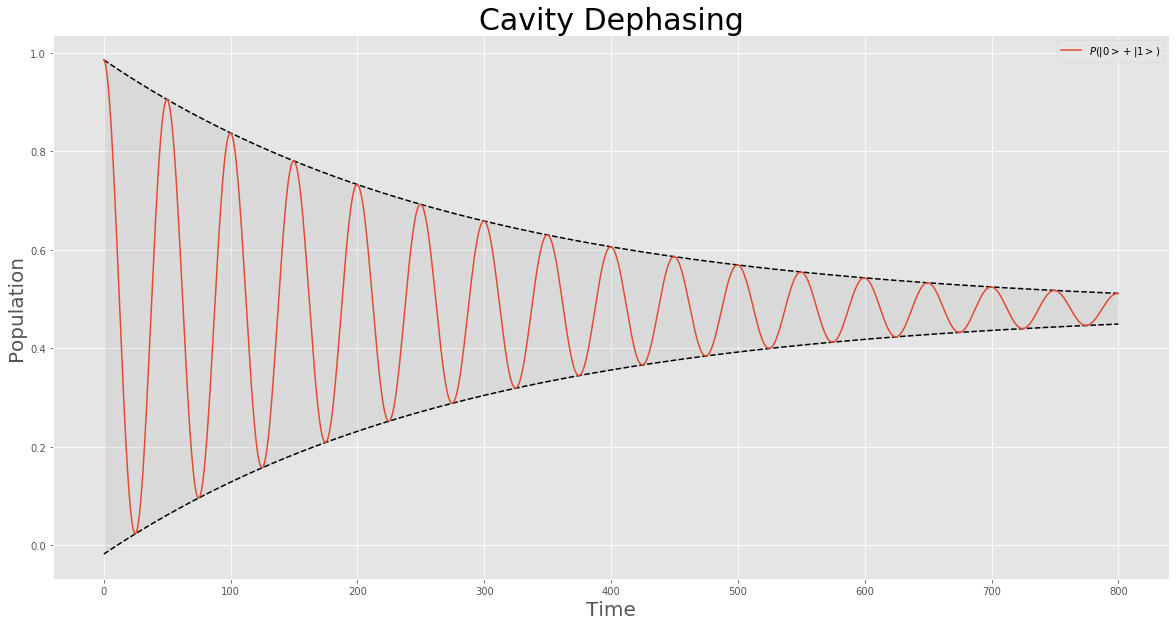
В физике дефазировка или фазовое затухание — это потеря фазовой когерентности между различными состояниями квантовой системы. Это один из видов декогеренции, который может способствовать потере информации в системе, даже если обмен энергией не происходит.
В квантовой суперпозиции состояния имеют относительную фазу, ответственную за интерференционные эффекты. Фазовое соотношение между различными состояниями хранит информацию о системе. Дефазировка может произойти, когда система становится коррелированной с внешней средой, а не с интересующей системой. [1] Если система подверглась значительной дефазировке, она перестает вести себя как когерентная суперпозиция с вероятностями, определяемыми квантовой механикой, и вместо этого ведет себя как классическая вероятностная смесь состояний. В этом смысле декогеренция восстанавливает классическое поведение квантовой системы.
Dephasing is an important effect in molecular and atomic спектроскопии, in nuclear and magnetic resonance (NMR), in the физике конденсированных сред of mesoscopic devices, and in quantum information, specifically в открытых квантовых системах . В методах визуализации и спектроскопии. In imaging and spectroscopy techniques such as MRI and NMR, dephasing can lead to decreased signal strength or image intensity.[2] In quantum information, dephasing in a quantum processor can cause noise and loss of information, making quantum computation unreliable.[3]
Фон
Теория декогеренции была разработана в 1970-х и 1980-х годах, чтобы попытаться объяснить, почему макроскопические элементы ведут себя классически в рамках квантовой механики. [4] Это потребовало теории открытых квантовых систем, которые относятся к системам, взаимодействующим с окружающей средой (в отличие от закрытых систем, которые не взаимодействуют). В открытых квантовых системах система взаимодействует с окружающей средой и неизбежно связывается с ней, вызывая декогеренцию.
The coherence of a sample is explained by the off-diagonal elements of a плотности. An external электрическое or магнитное поле can create coherences between two квантовыми состояниями in a sample if the энергетической corresponds to the energy gap between the two states. The coherence terms decay with the dephasing time or спин-спиновой релаксации, T2.
After coherence is created in a sample by light, the sample emits a поляризационную волну, the frequency of which is equal to and the фаза of which is inverted from the incident light. In addition, the sample is excited by the incident light and a population of molecules in the возбужденном состоянии . Свет, проходящий через образец is generated. The light passing through the sample is absorbed because of these two processes, and it is expressed by an спектром поглощения. The coherence decays with the времени, T2, and the intensity of the polarization wave is reduced. The population of the excited state also decays with the time constant of the релаксации, T1. The time constant T2 is usually much smaller than T1, and the bandwidth of the absorption spectrum is related to these time constants by the преобразованием Фурье, so the time constant T₂ является основным фактором 2 is a main contributor to the bandwidth. The time constant фотонным 2 has been measured with ultrafast времяразрешенной спектроскопии directly, such as in эхом . experiments.
Какова скорость дефазировки частицы с энергией E, если она находится в флуктуирующей среде с температурой T ? В частности, какова скорость дефазировки вблизи равновесия ( E~T ) и что происходит в пределе нулевой температуры? Этот вопрос занимал умы мезоскопического сообщества в течение последних двух десятилетий (см. ссылки ниже).
The reason can be understood by describing the conduction in metals as a classical phenomenon with quantum effects all embedded into an эффективной массе that can be computed quantum mechanically, as also happens to сопротивлением that can be seen as a рассеяния effect of электронов проводимости. When the temperature is lowered and the dimensions of the device are meaningfully reduced, this classical behaviour should disappear and the laws of quantum mechanics should govern the behavior of conducting electrons seen as waves that move баллистически inside the conductor without any kind of dissipation. Most of the time this is what one observes. But it appeared as a surprise[to whom?] to uncover that the so-called время дефазировки, that is the time it takes for the conducting electrons to lose their quantum behavior, becomes finite rather than infinite when the temperature approaches zero in mesoscopic devices violating the expectations of the theory of Бориса Альтшулера, Аркадия Аронова and David E. Khmelnitskii.[5] This kind of saturation of the dephasing time at low temperatures is an открытой проблемой even as several proposals have been put forward.
Примеры
- В спектроскопии ядерного магнитного резонанса (ЯМР) дефазировка между различными атомами водорода, прецессирующими вокруг магнитного поля, уменьшает сигнал измерения. [2]
- Similarly, in магнитно-резонансной томографии, (which is also based on magnetic resonance) spins of magnetic nuclei dephase due to the static magnetic field,[6] causing signal loss and reduced image quality.[citation needed]
- В атомной интерферометрии колебания в окружающей среде вызывают дефазировку траекторий атомных волн материи и уменьшают контраст интерференционных полос в атомных интерферометрах. [7][8]
- In сверхпроводящих кубитах, dephasing between the states of the приводит к случайному изменению состояния randomizes the qubit's суперпозиции state. The qubit dephasing is mostly caused by a variety of low-frequency noise sources (sometimes called {\textstyle 1/f} noise) such as charge and flux noise.[9]
См. также
Ссылки
- ↑ «Введение в нелинейную спектроскопию: дефазировка и релаксация». Группа Райта. Университет Висконсина, Мэдисон .
- 1 2 "дефазирование". glossary.slb.com. Retrieved 2026-01-14.
- ↑ Malewar, Amit (2023-04-10). «Формула, предсказывающая влияние шума окружающей среды на квантовую информацию». Tech Explorist. Retrieved 2026-01-14.
- ↑ Hornberger, Klaus (2006-12-14), "Introduction to Decoherence Theory", Запутанность и декогеренция, Lecture Notes in Physics, vol. 768, pp. 221–276, arXiv:quant-ph/0612118, doi:10.1007/978-3-540-88169-8_5, ISBN 978-3-540-88168-1
- ↑ Altshuler, B L; Aronov, A G; Khmelnitsky, D E (30 December 1982). "Effects of electron-electron collisions with small energy transfers on quantum localisation". Журнал физики C: Физика твердого тела. 15 (36): 7367–7386. Библиографический код:1982JPhC...15.7367A. doi:10.1088/0022-3719/15/36/018.
- ↑ "MRI Database : Dephasing". MR-TIP.com. Retrieved 2026-01-14.[Ненадежный источник?]
- ↑ Bistritzer, R.; Altman, E. (2007-06-12). «Внутреннее дефазирование в одномерных интерферометрах на основе ультрахолодных атомов». Труды Национальной академии наук. 104 (24): 9955–9959. arXiv:cond-mat/0609047. Bibcode:2007PNAS..104.9955B. doi:10.1073/pnas.0608910104. PMC 1891245. PMID 17548834.
- ↑ Jacquey, M; Miffre, A; Büchner, M; Trénec, G; Vigué, J (September 2006). "Phase noise due to vibrations in Mach-Zehnder atom interferometers". Europhysics Letters (EPL). 75 (5): 688–694. arXiv:quant-ph/0604028. Bibcode:2006EL.....75..688J. doi:10.1209/epl/i2006-10177-6.
- ↑ McDermott, R. (February 2009). "Materials Origins of Decoherence in Superconducting Qubits". Труды IEEE по прикладной сверхпроводимости. 19 (1): 2–13. Библиографический код:2009ITAS...19....2M. doi:10.1109/TASC.2008.2012255.
Другой
- Имри, Й. (1997). Введение в мезоскопическую физику . Издательство Оксфордского университета.(И ссылки в нем.)
- Aleiner, I. L.; Altshuler, B. L.; Gershenson, M. E. (1999). "Comment on "Quantum Decoherence in Disordered Mesoscopic Systems"". Physical Review Letters. 82 (15): 3190. arXiv:cond-mat/9808078. Bibcode:1999PhRvL..82.3190A. doi:10.1103/PhysRevLett.82.3190. S2CID 119348960.
- Cohen, D.; Imry, Y. (1999). "Dephasing at low temperatures". Physical Review B. 59 (17): 11143–11146. arXiv:cond-mat/9807038. Bibcode:1999PhRvB..5911143C. doi:10.1103/PhysRevB.59.11143. S2CID 51856292.
- Golubev, D. S.; Schön, G.; Zaikin, A. D. (2003). "Low-temperature dephasing and Renormalization in model systems". Journal of the Physical Society of Japan. 72 (Suppl. A): 30–35. arXiv:cond-mat/0208548. Bibcode:2003JPSJ...72S..30S. doi:10.1143/JPSJS.72SA.30. S2CID 119036267.
- Saminadayar, L.; Mohanty, P.; Webb, R. A.; Degiovanni, P.; Bäuerle, C. (2007). "Electron coherence at low temperatures: The role of magnetic impurities". Physica E. 40 (1): 12–24. arXiv:0709.4663. Bibcode:2007PhyE...40...12S. doi:10.1016/j.physe.2007.05.026. S2CID 13883162.
- Моханти, П. (2001). «О декогерентных электронах и неупорядоченных проводниках». В: Скьельторп, А.Т.; Вичек, Т. (ред.). Сложность от микроскопического до макроскопического масштаба: когерентность и большие отклонения . Kluwer. arXiv: cond-mat/0205274. Bibcode: 2002cond.mat..5274M.
- Frasca, M. (2003). "Saturation of dephasing time in mesoscopic devices produced by a ferromagnetic state". Physical Review B. 68 (19) 193413. arXiv:cond-mat/0308377. Bibcode:2003PhRvB..68s3413F. doi:10.1103/PhysRevB.68.193413. S2CID 119498061.
Источники
- Участники английской Википедии. «Dephasing». Перевод на русский. CC BY-SA 4.0 (текст и перевод).
Источники иллюстраций
- Text document with red question mark.svg · Benjamin D. Esham ( bdesham ) · Общественное достояние
- Cavity Dephasing Simulation.png · DnLch · CC BY-SA 4.0

