
Mammutidae
Семейство Mammutidae — вымершее семейство хоботных, принадлежащее к отряду Elephantimorpha. Оно наиболее известно благодаря мастодонтам (род Mammut ), которые населяли Северную Америку с позднего миоцена (около 8 миллионов лет назад) до своего вымирания в начале голоцена, около around 11,000 years ago. The earliest fossils of the group are known from the позднего олигоцена Африки, примерно 24 миллиона лет назад, а также были найдены по всей Евразии. Название «мастодон» происходит от древнегреческих слов μαστός (mastós ), означающего «сосок», и ὀδούς ( odoús ), означающего «зуб», что указывает на их характерные зубы.
Описание
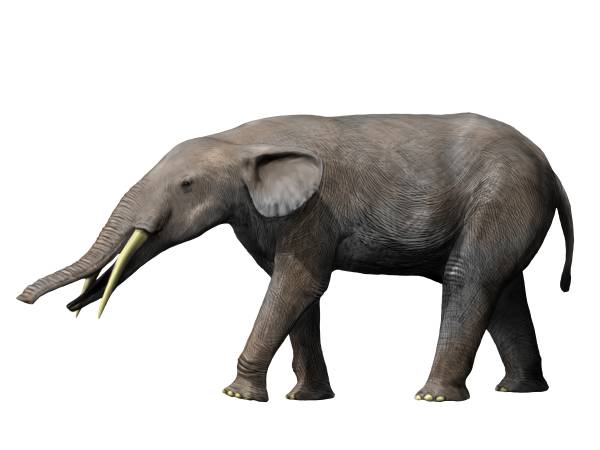
Mammutids are characterised by their zygodont molars, where pairs of parallel бугорков are merged into sharp-sided riges, which are morphologically conservative and differ little between mammutid species.[5] Like other members of Elephantimorpha, mammutids exhibited horizontal tooth replacement like modern elephants. Some authors have argued that horizontal tooth replacement развивалась параллельно in mammutids and members of Elephantida (which includes gomphotheres and elephants), though this is uncertain.[6] Compared to modern elephants, the bones of most mammutids were more robust, with the limb bones in particular being massive,[5] with the legs being proportionally shorter than living elephants, while their bodies were proportionally more elongate.[7] Early members of the group like Eozygodon and Zygolophodon had elongate симфиз нижней (the front-most part) of the lower jaws with lower incisors/tusks (which tend to be flattened and narrow in shape[7]), while in later representatives like Sinomammut and Mammut, the lower incisors/tusks were either lost or only vestigially present, and the lower jaws shortened (brevirostrine). This process happened convergently amongst other elephantimorph proboscideans, including гомфотериев, стегодонтидов, and слонов.[8][9] Mammutids are thought to have had prehensile trunks like those of living elephants, with those of маммута suggested to have been possibly long enough to reach the ground.[7] The upper tusks in primitive mammutids are relatively small as well as being downward (ventrally) and outward (laterally) curving, while those of mastodons (Mammut) are large and upward curving, often reaching around 3 метров (9.8 ft) in length.[7] The mammutid «Mammut» борсони is one of the largest of all proboscideans with an estimated average male body weight of 16 tonnes (35,000 lb) making it one of the largest land mammals of all time,[10] with the tusks of this species being the longest known of any animal, reaching over 5 метров (16 ft) in length.[11] The энцефализации of mammutids is lower than those of modern elephants, indicating mammutids had proportionally smaller brains relative to body size, though their brains are proportionally larger than those of more primitive non-elephantimorph proboscideans.[12]
 [3] Реконструкция внешнего вида Zygolophodon proavus, демонстрирующая удлиненную нижнюю челюсть с нижними клыками и изогнутые вниз верхние клыки.
 [4] Нижняя челюсть американского мастодонта ( Mammut americanum ) с зубами.
 [5] Размеры американского мастодонта ( Mammut americanum ) в сравнении с человеческим телом.
 [6] Размеры взрослого самца «Mammut» borsoni, крупнейшего из известных маммутов и одного из самых крупных наземных млекопитающих всех времен, в сравнении с человеком.
Экология
Считается, что представители семейства Mammutidae питались преимущественно листвой и ветвями деревьев и кустарников. [13][14][15] Челюсти маммутидов приспособлены к мощному вертикальному укусу (орто-движению), который служил для измельчения пищи и в значительно меньшей степени для ее перемалывания движением из стороны в сторону. [7] Анализ останков американского мастодонта ( Mammut americanum ) предполагает, что маммутиды имели социальную структуру, схожую с современными слонами, со стадами взрослых самок и детенышей, при этом взрослые самцы жили поодиночке или в группах с другими самцами, [16][17] при этом взрослые самцы периодически вступали в драки, подобные мусту, против других самцов. [16] Как и другие слонообразные и современные слоны, маммутиды, как полагают, использовали инфразвук для общения, а морфология их подъязычных костей и внутреннего уха предполагает, что они были способны как слышать, так и издавать инфразвуковые сигналы. [12]
Эволюция
Маммутиды являются наиболее базальной группой в пределах Elephantimorpha, а гомфотерии и другие представители Elephantida, такие как амебелодонты, более тесно связаны со слонами. [18][19] Кладограмма по Ли и др. (2024). [20]
| Слонообразные |
| ||||||||||||||||||||||||||||||||||||
Mammutids originated in Africa during the Late олигоцене, with the oldest genus Losodokodon dating to around 27.5-24 million years ago.[21] Mammutids belonging to the genus Zygolophodon (as well as possibly other mammutid genera) entered Eurasia across the "Гомфотериев сухопутный мост " during the early Miocene, around 18 million years ago. Mammutid remains are generally rare in Eurasia in comparison to contemporary gomphotheres and дейнотериями.[5] During the late early Miocene, around 16.5 million years ago,[22] a population of Zygolophodon entered North America, giving rise to Mammut.[5] The youngest confirmed records of mammutids in Africa date to around 13 million years ago, though possible Late Miocene fossils have been reported from North Africa.[23] At the beginning of the Pleistocene, around 2 to 2.5 million years ago, the last of the Eurasian mammutids, "Mammut" borsoni became extinct, with members of , а представители Mammut persisting in North America until the end of the Pleistocene, approximately 11,000 years ago.[5]
Ссылки
- ↑ Хей, Оливер Перри (1922). «Дальнейшие наблюдения за некоторыми вымершими слонами» (PDF). Труды Биологического общества Вашингтона. 35: 97–101. Получено 2019-10-07.
- ↑ Shoshani, Jeheskel; Pascal Tassy (2005). "Advances in proboscidean taxonomy & classification, anatomy & physiology, and ecology & behavior". Quaternary International. 126–128: 5–20. Bibcode:2005QuInt.126....5S. doi:10.1016/j.quaint.2004.04.011.
- ↑ Wang, S.-Q.; Zhang, X.-X.; Li, C.-X. (2020). "Reappraisal of Serridentinus gobiensis Osborn & Granger and Miomastodon tongxinensis Chen: the validity of Miomastodon" (PDF). Vertebrata PalAsiatica. doi:10.19615/j.cnki.1000-3118.200310. Archived from оригинала (PDF) on 2020-07-15. Retrieved 2020-03-15.
- ↑ Dimila Mothé; Leonardo S. Avilla; Desi Zhao; Guangpu Xie; Boyang Sun (2016). «Новые Mammutidae (Proboscidea, Mammalia) из позднего миоцена провинции Ганьсу, Китай». Анаис да Академия Бразилиа де Сиенсиас. 88 (1): 65–74. doi:10.1590/0001-3765201520150261. ПМИД 26839998.
- 1 2 3 4 5 Koenigswald, Wighart; Březina, Jakub; Werneburg, Ralf; Göhlich, Ursula (2022). «Частичный скелет «Mammut» borsoni (Proboscidea, Mammalia) из плиоцена Кальтенсундхайма (Германия)». Электронная палеонтология. 27 (1): 1–20. дои:10.26879/1188.
- ↑ Sanders, William J. (2018-02-17). «Горизонтальное смещение зубов и наличие премоляров у слонов и других слонообразных хоботных». Историческая биология. 30 (1–2): 137–156. Библиографический код:2018HBio...30..137S. doi:10.1080/08912963.2017.1297436. ISSN 0891-2963. S2CID 89904463.
- 1 2 3 4 5 Nabavizadeh, Ali (2024-10-08). «О бивнях и хоботах: обзор эволюционной анатомии черепно-лицевой области у слонов и вымерших хоботных». Анатомический журнал. doi:10.1002/ar.25578. ISSN 1932-8486.
- ↑ Mothé, Dimila; Avilla, Leonardo S.; Zhao, Desi; Xie, Guangpu; Sun, Boyang; Mothé, Dimila; Avilla, Leonardo S.; Zhao, Desi; Xie, Guangpu (2016). «Новые Mammutidae (Proboscidea, Mammalia) из позднего миоцена провинции Ганьсу, Китай». Анаис да Академия Бразилиа де Сиенсиас. 88 (1): 65–74. doi:10.1590/0001-3765201520150261. ISSN 0001-3765. ПМИД 26839998.
- ↑ Mothé, Dimila; Ferretti, Marco P.; Avilla, Leonardo S. (2016-01-12). Beatty, Brian Lee (ed.). «Танец клыков: повторное открытие нижних резцов у панамериканского хоботного Cuvieronius hyodon пересматривает эволюцию резцов у Elephantimorpha». PLOS ONE. 11 (1) e0147009. Bibcode:2016PLoSO..1147009M. doi:10.1371/journal.pone.0147009. ISSN 1932-6203. PMC 4710528. PMID 26756209.
- ↑ Larramendi, A. (2016). «Высота плеч, масса тела и форма хоботных» (PDF). Acta Palaeontologica Polonica. 61. doi:10.4202/app.00136.2014.
- ↑ Larramendi, Asier (2023-12-10). «Оценка массы клыков у хоботных: всесторонний анализ и прогностическая модель». Историческая биология: 1–14. doi:10.1080/08912963.2023.2286272. ISSN 0891-2963.
- 1 2 Benoit, Julien; Lyras, George A.; Schmitt, Arnaud; Nxumalo, Mpilo; Tabuce, Rodolphe; Obada, Teodor; Mararsecul, Vladislav; Manger, Paul (2023), «Палеоневрология хоботков (млекопитающих, афротерий): идеи их мозга, эндокаст и лабиринт», in Dozo, María Teresa; Paulina-Carabajal, Ariana; Macrini, Thomas E.; Walsh, Stig (eds.), Палеоневрология амниотов, Cham: Springer International Publishing, pp. 579–644, doi:10.1007/978-3-031-13983-3_15, ISBN 978-3-031-13982-6Получено 2025-06-16
- ↑ Saarinen, Juha; Lister, Adrian M. (2023-08-14). «Колебания климата и инновации в питании привели к ступенчатой эволюции зубных признаков хоботных». Nature Ecology & Evolution. 7 (9): 1490–1502. Bibcode:2023NatEE...7.1490S. doi:10.1038/s41559-023-02151-4. ISSN 2397-334X. PMC 10482678. PMID 37580434.
- ↑ Janis, C (May 2004). «Видовое богатство миоценовых травоядных животных и его значение для типа местообитания и первичной продуктивности в североамериканском луговом биоме». Палеогеография, палеоклиматология, палеоэкология. 207 (3–4): 371–398. Библиографический код:2004PPP...207..371J. doi:10.1016/j.palaeo.2003.09.032.
- ↑ Rivals, Florent; Semprebon, Gina M.; Lister, Adrian M. (September 2019). «Особенности питания и вариативность рациона плейстоценовых хоботных: обзор микроизноса зубов». Quaternary Science Reviews. 219: 145–153. Bibcode:2019QSRv..219..145R. doi:10.1016/j.quascirev.2019.06.027. S2CID 200073388.
- 1 2 Miller, Joshua H.; Fisher, Daniel C.; Crowley, Brooke E.; Secord, Ross; Konomi, Bledar A. (2022). «Изменение ландшафтного использования самцами мастодонтов с созреванием (поздний плейстоцен, Северная Америка)». Труды Национальной академии наук. 119 (25) e2118329119. Библиографический код:2022PNAS..11918329M. doi:10.1073/pnas.2118329119. ISSN 0027-8424. PMC 9231495. PMID 35696566.
- ↑ Haynes, G.; Klimowicz, J. (2003). "Mammoth (Mammuthus spp.) and American mastodont (Mammut americanum) bonesites: what do the differences mean?". Достижения в исследованиях мамонтов. 9: 185–204.
- ↑ Shoshani, J.; Ferretti, M.P.; Lister, A.M.; Agenbroad, L.D.; Saegusa, H.; Mol, D.; Takahashi, K. (July 2007). "Relationships within the Elephantinae using hyoid characters". Quaternary International. 169–170: 174–185. Bibcode:2007QuInt.169..174S. doi:10.1016/j.quaint.2007.02.003. ISSN 1040-6182.
- ↑ Baleka, Sina; Varela, Luciano; Tambusso, P. Sebastián; Paijmans, Johanna L.A.; Mothé, Dimila; Stafford, Thomas W.; Fariña, Richard A.; Hofreiter, Michael (December 2021). "Revisiting proboscidean phylogeny and evolution through total evidence and palaeogenetic analyses including Notiomastodon ancient DNA". iScience. 25 (1) 103559. doi:10.1016/j.isci.2021.103559. PMC 8693454. PMID 34988402.
- ↑ Li, Chunxiao; Deng, Tao; Wang, Yang; Sun, Fajun; Wolff, Burt; Jiangzuo, Qigao; Ma, Jiao; Xing, Luda; Fu, Jiao; Zhang, Ji; Wang, Shiqi (2024-06-20). «Хобот заменяет более длинную нижнюю челюсть в качестве основного органа питания в эволюции слонов». электронная жизнь. 12. дои:10.7554/eLife.90908.3. ISSN 2050-084X.
- ↑ Sanders, William J. (2023-07-07). Эволюция и ископаемые остатки африканских хоботных (1 ed.). Boca Raton: CRC Press. pp. 48, 117. doi:10.1201/b20016. ISBN 978-1-315-11891-8.
- ↑ Кёнигсвальд, Видга и Гёлих (2021): Новые маммутиды (хоботные) из кларендонского и хемфилльского ярусов Орегона – обзор мио-плиоценовых маммутидов Северной Америки
- ↑ Пикфорд, М. 2007. Новые зубы хоботных маммутид из среднего миоцена тропической и южной Африки. Palaeontologia Africana 42: 29–35.
Роды отряда хоботных | |||||||||||||||||||||||||||||
|---|---|---|---|---|---|---|---|---|---|---|---|---|---|---|---|---|---|---|---|---|---|---|---|---|---|---|---|---|---|
| |||||||||||||||||||||||||||||
| |||||||||||||||||||||||||||||


Источники
- Участники английской Википедии. «Mammutidae». Перевод на русский. CC BY-SA 4.0 (текст и перевод).
Источники иллюстраций
- Mammut skeleton Museum of the Earth.jpg · Jayu from Harrisburg, PA, U.S.A. · CC BY-SA 2.0
- OOjs UI icon edit-ltr.svg · MGalloway (WMF) · CC BY-SA 3.0
- Miomastodon proavusDB.jpg · ДиБгд · CC BY 4.0
- Aurora Mastodon Lower Jaw and Tooth.jpg · Zissoudisctrucker · CC BY-SA 4.0
- Warren mastodon size comparison.jpg · Asier Larramendi · CC BY 4.0
- Mammut borsoni from Milia.jpg · Larramendi A. · CC BY-SA 4.0
- Commons-logo.svg · Лицензия файла уточняется (Wikimedia Commons logo)
- Wikispecies-logo.svg · Лицензия файла уточняется (Wikispecies logo)
- Barytherium graveDB1.jpg · DiBgd · CC BY-SA 4.0
- BlankMastodon.jpg · en:User:Dantheman9758 · CC BY-SA 3.0
- Gomphotherium NT small.jpg · Nobu Tamura email:nobu.tamura@yahoo.com http://spinops.blogspot.com/ · CC BY-SA 4.0


