
Морское перо
Морские перья are морские книдарии, belonging to the надсемейству Pennatuloidea. They are fleshy colonial organisms anchored to the seabed, with tiny polyps embedded in a soft matrix. They have a космополитическое распространение, being found in tropical and temperate waters worldwide, from приливных мелководий до to морей of more than 6,100 m (20,000 ft).[1]
Самые ранние признанные окаменелости морских перьев известны из кембрийских сланцев Берджесс ( Таумаптилон ). Подобные окаменелости из эдиакарского периода могут свидетельствовать о зарождении морских перьев. [2] Однако точно определить, к какому типу относятся эти ранние окаменелости, пока не решено. [3]
Таксономия
Морские перья are морские книдарии, belonging to the надсемейству Pennatuloidea,[4] which are бентосные -forming фильтраторы в within the order Scleralcyonacea.[4][1] The order comprises 16 семейств and 44 extant рода, with around 235 accepted видов.[5] The superfamily Pennatulacea consists of the following families:[4]
- Anthoptilidae Kölliker, 1880
- Balticinidae Balss, 1910
- Chunellidae Kükenthal, 1902
- Echinoptilidae Hubrecht, 1885
- Funiculinidae Gray, 1870
- Gyrophyllidae Лопес-Гонсалес, Дрювери и Уильямс, 2022 г.
- Kophobelemnidae Gray, 1860
- Pennatulidae Ehrenberg, 1834
- Protoptilidae Kölliker, 1872
- Pseudumbellulidae López-González в López-González & Drewery, 2022 г.
- Рениллида Грей, 1870
- Scleroptilidae Юнгерсен, 1904 г.
- Stachyptilidae Kölliker, 1880
- Umbellulidae Lindahl, 1874 (1840)
- Veretillidae Herklots, 1858
- Virgulariidae Verrill, 1868
Биология
Благодаря широкому географическому распространению и долгой эволюционной истории, генетическая изменчивость внутри различных видов морских перьев довольно велика. На протяжении эволюции большинство морских перьев сохранили свой первоначальный порядок митохондриальных генов, но определенная группа морских перьев продемонстрировала уникальные перестройки в результате реконструкции предкового состояния. Существует множество популяций морских перьев, обитающих в основном в водах Индии. Генетически затронуты их полипы, поскольку они расселились по различным водам и островам, а также то, как они используют свои полипы (щупальца) для защиты себя и других видов. [6]


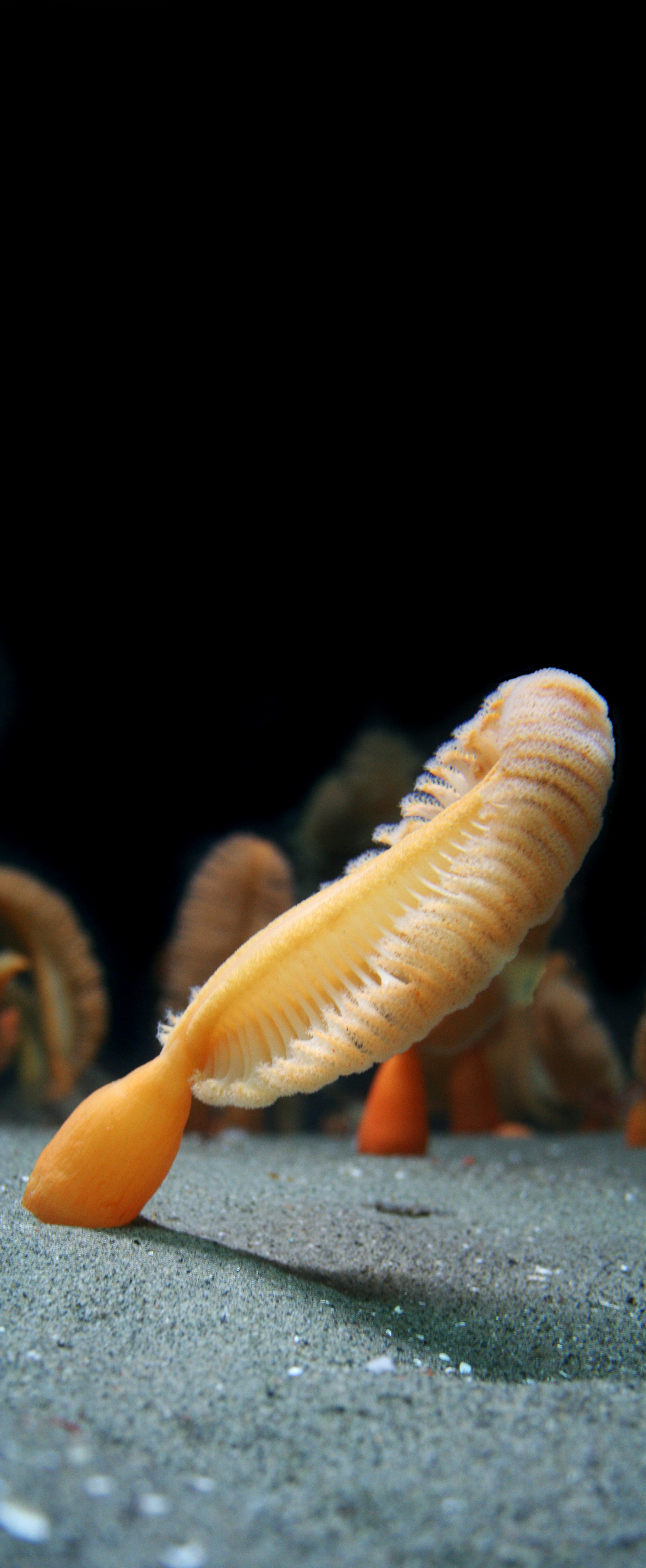
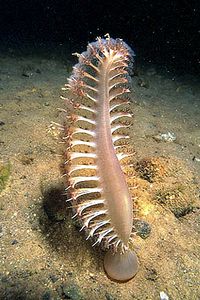
As восьмилучевые кораллы, sea pens are colonial animals with multiple полипов (which look somewhat like miniature морские анемоны), each with eight щупалец . Однако, в отличие от других восьмилучевых кораллов,. Unlike other octocorals, however, a sea pen's полипы are specialized to specific functions: a single polyp develops into a rigid, erect stalk (the рахис) and loses its tentacles, forming a bulbous "root" or педункул at its base.[7] The other polyps branch out from this central stalk, forming water intake structures (сифонозоиды), feeding structures (автозооиды) with нематоцистами, and reproductive structures. The entire colony is fortified by calcium carbonate in the form of спикул and a central осевого стержня.[citation needed]
Using their root-like peduncles to anchor themselves in sandy or muddy substrate, the exposed portion of sea pens may rise up to ), может подниматься до 2 метров (6.6 ft) in some species, such as the tall sea pen (Funiculina quadrangularis). Sea pens are sometimes brightly coloured; the оранжевый морской перо (Ptilosarcus gurneyi) is a notable example. Rarely found above depths of 10 метров (33 ft), sea pens prefer deeper waters where turbulence is less likely to uproot them. Some species may inhabit depths of 2,000 metres (6,600 ft) or more.[citation needed]
While generally sessile animals, sea pens are able to relocate and re-anchor themselves if need be.[7] They position themselves favourably in the path of currents, ensuring a steady flow of планктона, the sea pens' chief source of food. Their primary predators are голожаберные моллюски and морские звезды, some of which feed exclusively on sea pens. The sea pens' ability to be clumped together and spatially unpredictable hinders sea stars' predation abilities.[8] When touched, some sea pens emit a bright greenish light; this is known as биолюминесценция. They may also force water out of their bodies for defence, rapidly deflating and retreating into their peduncle.[citation needed]
Like other антозои, sea pens reproduce by coordinating a release of sperm and eggs into the water column; this may occur seasonally or throughout the year. Fertilized eggs develop into larvae called планулами which drift freely for about a week before settling on the substrate. Mature sea pens provide shelter for other animals, such as juvenile рыб. Analysis of rachis growth rings indicates sea pens may live for 100 years or more, if the rings are indeed annual in nature.[citation needed]
Некоторые морские перья обладают симметрией скольжения и отражения [9], что редко встречается среди ныне живущих животных.
Торговля аквариумными товарами
Морские перья иногда продаются в зоомагазинах. Однако, как правило, за ними сложно ухаживать, поскольку им необходим очень глубокий грунт и особый рацион питания.[требуется ссылка]
Галерея




Ссылки
- 1 2 Williams, Gary C. (2011-07-29). «Глобальное разнообразие морских перьев (Cnidaria: Octocorallia: Pennatulacea)». PLoS ONE. 6 (7) e22747. Библиографический код:2011PLoSO...622747W. doi:10.1371/journal.pone.0022747. PMC 3146507. PMID 21829500.
- ↑ Williams, Gary C. «Аспекты эволюционной биологии пеннатулярных восьмилучевых кораллов». Department of Invertebrate Zoology and Geology. California Academy of Sciences. Retrieved 2023-01-27.
- ↑ Antcliffe, J.B.; Brasier, M.D. (2008). «Харния в 50 лет: модели развития эдиакарских ветвей». Палеонтология. 51 (1): 11–26. Библиографический код:2008Palgy..51...11A. doi:10.1111/j.1475-4983.2007.00738.x. S2CID 83486435.
- 1 2 3 World List of Octocorallia. McFadden, C.S.; Cordeiro, R.; Samimi-Namin, K.; Williams, G.; van Ofwegen, L. (eds.). "Pennatuloidea Ehrenberg, 1834". Всемирный реестр морских видов. Retrieved 7 сентября 2025.
- ↑ World List of Octocorallia. McFadden, C.S.; Cordeiro, R.; Samimi-Namin, K.; Williams, G.; van Ofwegen, L. (eds.). "Pennatuloidea treeview". Всемирный реестр морских видов. Retrieved 7 сентября 2025.
- ↑ De Clippele, L. H.; Buhl-Mortensen, P.; Буль-Мортенсен, Л. (15 August 2015). "Fauna associated with cold water gorgonians and sea pens". Исследования континентального шельфа. 105: 67–78. doi:10.1016/j.csr.2015.06.007.
- 1 2 Barnes, Robert D. (1982). Зоология беспозвоночных. Philadelphia, PA: Holt-Saunders International. pp. 168–169. ISBN 0-03-056747-5.
- ↑ Birkeland, Charles (February 1974). "Interactions between a Sea Pen and seven of its predators". Экологические монографии. 44 (2): 211–232. Библиографический код:1974EcoM...44..211B. doi:10.2307/1942312. JSTOR 1942312.
- ↑ Zubi, Teresa (2016-01-02). «Октокораллы (столониферы, мягкие кораллы, морские вееры, горгонарии, морские загоны) — Фотографии морских звезд — Achtstrahlige Korallen (Röhrenchorallen, Weichkorallen, Hornkoralllen, Seefedern, Fächerkorallen)». starfish.ch. Retrieved 2016-09-08.
Внешние ссылки
- «Фотографии морских перьев». starfish.ch .
Источники
- Участники английской Википедии. «Sea pen». Перевод на русский. CC BY-SA 4.0 (текст и перевод).
Источники иллюстраций
- Haeckel Pennatulida.jpg · Ernst Haeckel · Общественное достояние
- OOjs UI icon edit-ltr.svg · MGalloway (WMF) · CC BY-SA 3.0
- Sea pen uprooted.jpg · Unknown author · Общественное достояние
- Pierre's armina feeding on purple sea pen DSC09784.jpg · Pbsouthwood · CC BY-SA 3.0
- Sea pen2.jpg · Bradley Davis · CC BY 2.0
- Actinoptilum molle at Windmill BeachPA111765.JPG · Peter Southwood · CC BY-SA 3.0
- Sea Pansy - Flickr - Andrea Westmoreland (1).jpg · Andrea Westmoreland from DeLand, United States · CC BY-SA 2.0
- Pennatula phosphorea.jpg · Pino Bucca Original uploader was Yoruno at it.wikipedia · CC BY-SA 3.0
- Veretillum sp. (Sea pen) at night.jpg · Nhobgood Nick Hobgood · CC BY-SA 3.0
- Virgularia sp. (Purple sea pen).jpg · Nhobgood Nick Hobgood · CC BY-SA 3.0
- Commons-logo.svg · Лицензия файла уточняется (Wikimedia Commons logo)
- Wikispecies-logo.svg · Лицензия файла уточняется (Wikispecies logo)
- FFS Table bottom.jpg · Yumi Yasutake, NOAA · Общественное достояние


